

ICU setup
ICU at Home: What Medical Equipment Do You Actually Need?
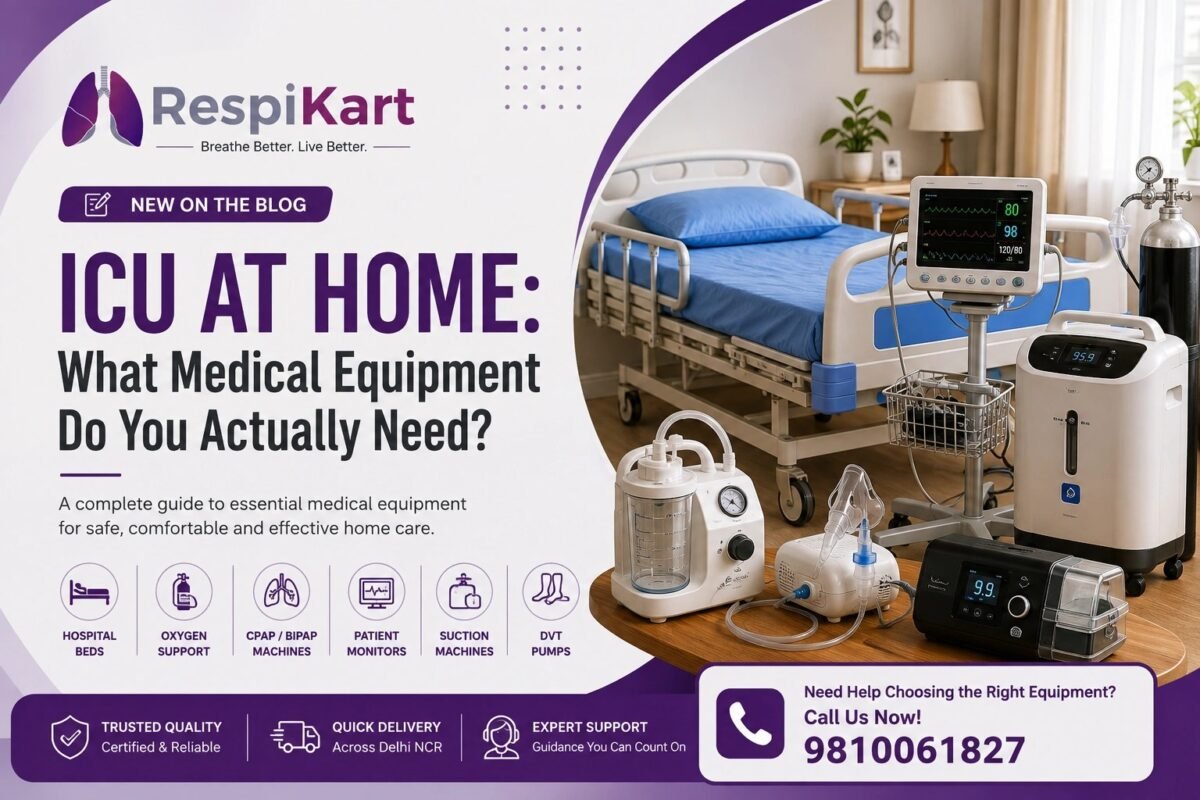
ICU at Home: What Medical Equipment Do You Actually Need?
A practical guide to setting up safe and comfortable home-based patient care with the right medical equipment, monitoring devices and respiratory support.
When a patient is discharged from the hospital but still requires medical support, families may need to arrange a suitable home healthcare setup.
Depending on the patient’s condition, this may involve a hospital bed, oxygen support, respiratory equipment, monitoring devices, suction equipment and other medical devices.
However, an ICU-at-home setup should never be based on a standard shopping list. The equipment required depends on the patient’s medical condition, doctor’s prescription, mobility, oxygen requirement and level of monitoring needed.
Respikart helps families arrange medical equipment for home-care requirements through rental and purchase options, depending on the product and location.
Quick Overview: ICU at Home Equipment
Depending on the patient’s requirements, a home-care setup may include:
What Is an ICU at Home?
An ICU at home refers to a home-care arrangement where certain medical support, monitoring and patient-care requirements are provided in a patient’s home instead of a hospital setting.
The level of care can vary significantly from one patient to another. Some patients may only need supportive equipment such as a hospital bed and oxygen concentrator, while others may require more advanced respiratory support and monitoring.
There is no universal “ICU at home equipment list.” Equipment should be selected according to the patient’s medical condition and the treating healthcare professional’s advice.
When Might a Patient Need Medical Equipment at Home?
Home medical equipment may be required in several situations, including:
- Recovery after hospitalization
- Recovery after major surgery
- Prolonged bed rest or limited mobility
- Certain respiratory conditions
- Long-term supportive care
- Elderly or dependent patients requiring assistance
- Patients requiring prescribed oxygen or non-invasive ventilation
What Medical Equipment Is Needed for an ICU at Home?
The following equipment may be considered depending on the patient’s medical requirements.
Electric Hospital Bed
An electric hospital bed can make patient positioning and caregiving easier, particularly for patients who spend extended periods in bed.
Depending on the model, features may include adjustable backrest, leg section, height adjustment and side rails.
Oxygen Concentrator
An oxygen concentrator delivers concentrated oxygen from surrounding air when supplemental oxygen has been prescribed.
Depending on the requirement, 5 LPM, 10 LPM and portable oxygen concentrators may be available.
Oxygen Cylinder
An oxygen cylinder can provide supplemental oxygen and may also be useful as a backup source in situations where uninterrupted oxygen availability is important.
CPAP / BiPAP Machine
CPAP and BiPAP machines provide non-invasive respiratory support for selected medical conditions.
The appropriate device and settings should be determined by a qualified healthcare professional.
Patient Monitor
Patient monitors can help track vital parameters depending on the model.
These may include ECG, SpO₂, NIBP, respiratory rate and temperature.
Suction Machine
A suction machine may be required for selected patients who cannot effectively clear respiratory or oral secretions.
Proper instruction and training should be provided before use.
DVT Pump
A DVT pump may use intermittent pneumatic compression to support blood circulation in selected patients with limited mobility.
Nebulizer
A nebulizer converts certain prescribed liquid medications into a mist that can be inhaled through a mask or mouthpiece.
Pulse Oximeter
A pulse oximeter can measure SpO₂ and pulse rate and may be useful for monitoring patients when recommended by their healthcare team.
Air Mattress
Patients spending prolonged periods in bed may require appropriate pressure-management support.
An air mattress may be considered based on the patient’s mobility and clinical requirements.
1. Electric Hospital Bed: The Foundation of Home Patient Care
For a patient who spends most of the day in bed, choosing an appropriate hospital bed can make everyday care easier for both the patient and caregiver.
Compared with a standard household bed, an electric hospital bed can provide adjustable positioning and easier access for caregivers.
Depending on the model, features may include:
- Adjustable backrest
- Adjustable leg section
- Height adjustment
- Side rails
- Wheels with locking mechanism
- Remote-controlled positioning
2. Oxygen Concentrator: When Supplemental Oxygen Is Prescribed
Oxygen concentrators are commonly used when a patient has been prescribed supplemental oxygen therapy.
Unlike an oxygen cylinder, a concentrator uses surrounding air and delivers concentrated oxygen through the device.
Respikart offers different oxygen concentrator options, including 5 LPM, 10 LPM and portable oxygen concentrators, subject to availability.
3. Oxygen Cylinder: A Useful Backup Option
Even when an oxygen concentrator is being used, some families may keep an oxygen cylinder as a backup depending on the patient’s medical requirement.
This can be particularly relevant when uninterrupted oxygen availability is important and the concentrator depends on electrical power.
4. CPAP & BiPAP: Respiratory Support at Home
CPAP and BiPAP are non-invasive positive airway pressure devices. They are used for different clinical indications depending on the patient’s condition and medical prescription.
CPAP
CPAP generally provides continuous positive airway pressure and is commonly used in the treatment of obstructive sleep apnea.
BiPAP
BiPAP provides different pressure levels during inhalation and exhalation and may be prescribed for selected respiratory conditions.
Pressure settings, modes and other therapy parameters should be changed only under appropriate medical guidance.
5. Patient Monitor: Keeping Track of Vital Parameters
For selected patients, a patient monitor can provide useful information about vital signs.
| Parameter | What It Indicates |
|---|---|
| ECG | Electrical activity of the heart |
| SpO₂ | Blood oxygen saturation |
| NIBP | Non-invasive blood pressure |
| RESP | Respiratory rate |
| TEMP | Body temperature |
6. Suction Machine: Supporting Airway and Secretion Management
Some patients may have difficulty clearing secretions independently. In such situations, a suction machine may be prescribed as part of the patient’s care plan.
It uses negative pressure to remove secretions through appropriate suction equipment.
Caregivers should receive proper instructions before using suction equipment.
7. DVT Pump: Supporting Circulation During Limited Mobility
Patients who remain inactive or bedridden for prolonged periods may have an increased risk of venous blood clots.
A DVT pump uses intermittent pneumatic compression in selected patients to help support circulation in the legs.
8. Nebulizer: For Prescribed Inhaled Medication
A nebulizer converts certain liquid medications into a fine mist that can be inhaled through a mask or mouthpiece.
An oxygen concentrator provides supplemental oxygen, while a nebulizer is used to deliver prescribed medication as an inhaled mist.
9. Pulse Oximeter: Simple Oxygen Monitoring
A pulse oximeter is a compact device commonly placed on the finger to measure SpO₂ and pulse rate.
It can be useful for routine monitoring when recommended by a healthcare professional.
However, readings should always be considered together with the patient’s symptoms and overall clinical condition.
10. Air Mattress and Pressure Management
Patients who spend extended periods in bed may need appropriate pressure-management support.
An air mattress may be considered depending on the patient’s mobility, duration of bed rest and healthcare requirements.
How to Plan an ICU-at-Home Setup?
Instead of purchasing equipment randomly, families can follow a structured approach.
Home ICU Caregiver Checklist
Equipment is only one part of home-based patient care. Caregivers should also make sure the home environment is prepared.
- Keep the patient’s medical documents easily accessible.
- Keep doctor’s contact information available.
- Understand how each medical device operates.
- Check power requirements for electrical equipment.
- Keep required accessories and consumables available.
- Maintain cleanliness around the patient’s equipment.
- Know how to respond to equipment alarms.
- Have an emergency contact plan ready.
- Follow prescribed medicines and therapy instructions.
- Do not change device settings without medical guidance.
Why Power Backup Matters in Home Medical Care
Many medical devices used in home care require electricity. Oxygen concentrators, CPAP/BiPAP machines, patient monitors and other equipment may stop functioning if power is interrupted.
Families should therefore discuss appropriate backup arrangements with their healthcare team, particularly when a patient’s therapy depends on continuous electrical equipment.
Before bringing equipment home, understand its power consumption, backup requirements and what should be done in case of a power failure.
Should You Rent or Buy Medical Equipment?
The decision between renting and buying depends mainly on the expected duration of use, budget and the patient’s long-term requirements.
When Renting May Be Better
- Short-term recovery
- Post-surgery care
- Equipment required for a few weeks or months
- Temporary respiratory support
- When you want to avoid a large upfront cost
When Buying May Be Better
- Long-term requirement
- Regular or continuous use
- Ongoing medical condition
- Equipment likely to be needed for an extended period
Medical Equipment for Home Care from Respikart
Finding the right medical equipment during a patient’s recovery can be stressful, especially when equipment is required urgently.
Respikart provides a range of medical equipment for home-care requirements, with rental and purchase options available for selected products and locations.
Medical Equipment Rental in Delhi NCR
Respikart serves customers across selected areas of Delhi NCR with medical equipment rental and purchase options, subject to product availability and location.
Depending on the product and location, local delivery options may also be available for urgent home-care requirements.
Frequently Asked Questions About ICU at Home
Can an ICU be set up at home?
What equipment is needed for an ICU at home?
Can ICU equipment be rented for home use?
Do I need both an oxygen concentrator and oxygen cylinder?
Is a patient monitor necessary at home?
Can I use CPAP or BiPAP without a doctor’s prescription?
How do I know which medical equipment my patient needs?
Need Medical Equipment for Home Care?
From hospital beds and oxygen concentrators to CPAP/BiPAP machines, patient monitors, suction machines and DVT pumps, Respikart can help you explore suitable medical equipment for home-care requirements.
Explore Respikart Explore Medical Rentals