

Oxygen Concentrator
Can You Sleep While Using an Oxygen Concentrator? What Patients Should Know
Can You Sleep While Using an Oxygen Concentrator? What Patients Should Know
A complete guide to nighttime oxygen therapy, oxygen concentrator setup, prescribed flow rates, safety precautions, CPAP use, power-failure planning and choosing the right home oxygen equipment.
If you or someone in your family has been prescribed oxygen therapy, one of the first questions that may come to mind is: “Can I sleep while using an oxygen concentrator?”
For many patients who have been specifically prescribed oxygen during sleep, an oxygen concentrator can be used as part of their nighttime oxygen routine. However, the machine should be used according to the healthcare professional’s instructions, including the prescribed oxygen flow and duration.
Nighttime oxygen therapy also requires more than simply switching on the concentrator. The equipment needs to be positioned correctly, the oxygen tubing needs to be safely arranged, ventilation openings must remain unobstructed and the entire setup needs to be kept away from smoking and open flames.
In this Respikart guide, we explain the important things patients, caregivers and families should know before using an oxygen concentrator during sleep.
Yes, you may be able to sleep while using an oxygen concentrator if nighttime oxygen has been prescribed for you. The correct oxygen flow, duration and equipment setup should be determined according to your medical requirements.
Do not start oxygen therapy, stop prescribed oxygen or change the oxygen flow rate simply because you feel better, worse or notice a different pulse-oximeter reading.
- What is an oxygen concentrator?
- Can you sleep while using one?
- How to set up oxygen before bedtime
- Oxygen concentrator and CPAP
- Oxygen safety rules
- What happens during a power cut?
- Oxygen concentrator vs oxygen cylinder
- Buying vs renting an oxygen concentrator
- Nighttime oxygen checklist
- Frequently asked questions
What Is an Oxygen Concentrator?
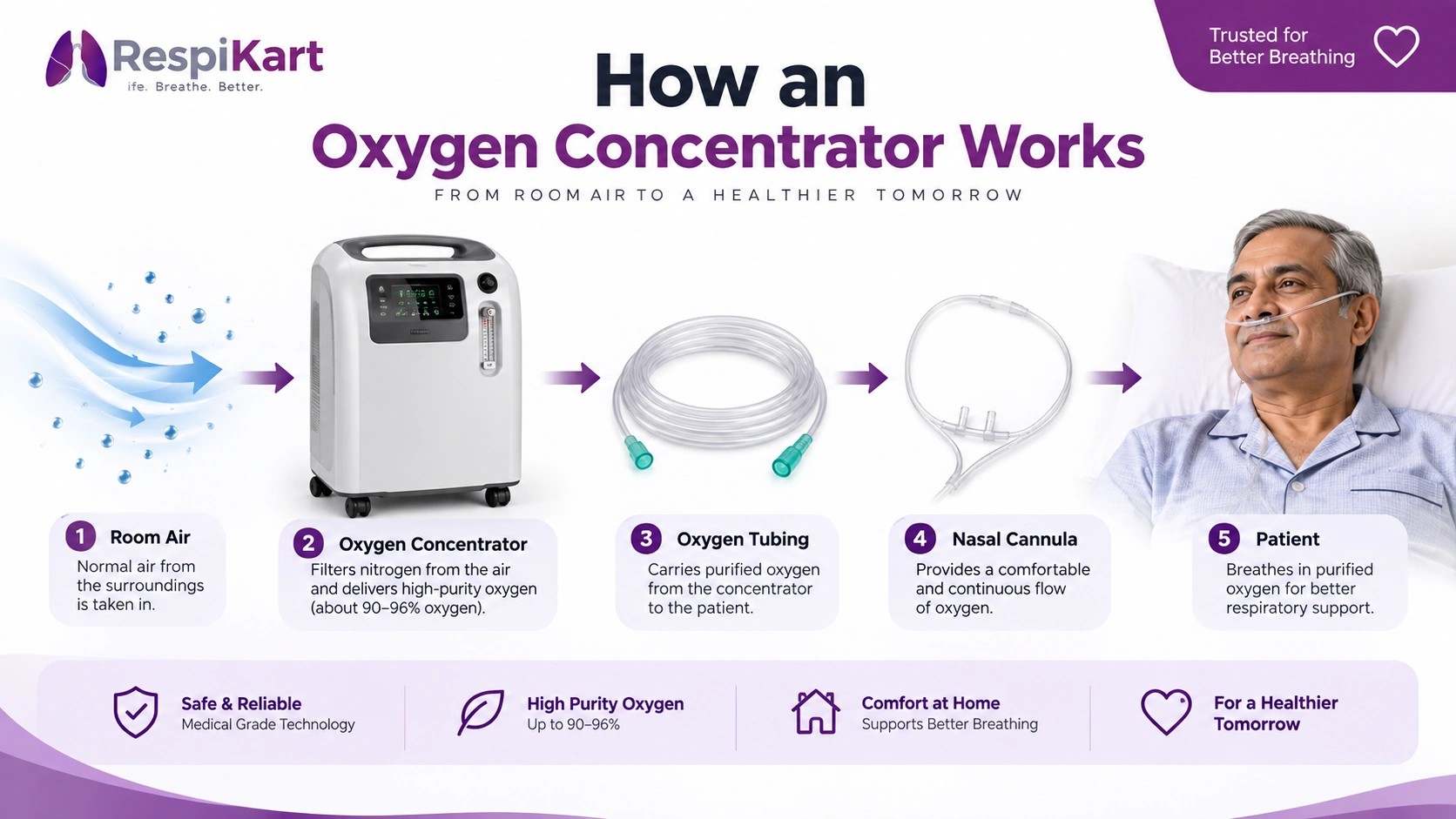
An oxygen concentrator is a medical device designed to provide supplemental oxygen by taking in surrounding room air and concentrating oxygen for delivery to the patient.
The concentrated oxygen is delivered through tubing and is commonly used with a nasal cannula. Depending on the equipment and prescription, different oxygen delivery systems may be used.
Unlike a conventional oxygen cylinder, a concentrator does not simply contain a fixed volume of compressed oxygen. A concentrator operates using a power source and produces concentrated oxygen while it is running.
Oxygen concentrators are available in different configurations and capacities. The appropriate device depends on the patient’s prescribed oxygen flow, intended duration of use and whether the equipment is required primarily at home or for mobility.
If you are exploring oxygen equipment, visit the Respikart Oxygen Concentrator category to explore available options.
Can You Sleep While Using an Oxygen Concentrator?
If your healthcare professional has prescribed oxygen during sleep, the oxygen concentrator may be used while you are sleeping.
Some patients may need oxygen only during specific periods, such as nighttime, while others may require oxygen for longer periods of the day. The exact requirement is individual and should not be copied from another patient’s oxygen prescription.
Sleeping with an oxygen concentrator is therefore not simply a question of whether the machine can remain switched on. The more important question is whether nighttime oxygen has been prescribed for your specific medical needs.
If you have not been prescribed oxygen therapy, do not start using an oxygen concentrator simply because you feel breathless at night or because someone else in your family uses oxygen.
Why Might Someone Need Oxygen During Sleep?
Sleep changes breathing patterns and, in some people with underlying medical conditions, oxygen levels may decrease during sleep.
A healthcare professional may assess whether supplemental oxygen is appropriate based on the patient’s symptoms, medical history, oxygen measurements and other relevant clinical assessments.
The important point is that nighttime breathing problems do not always mean that oxygen therapy is the appropriate treatment.
For example, some patients with sleep-related breathing disorders may require positive airway pressure therapy such as CPAP rather than oxygen alone.
This is why the cause of nighttime breathing difficulty or low oxygen levels should be evaluated by a qualified healthcare professional.
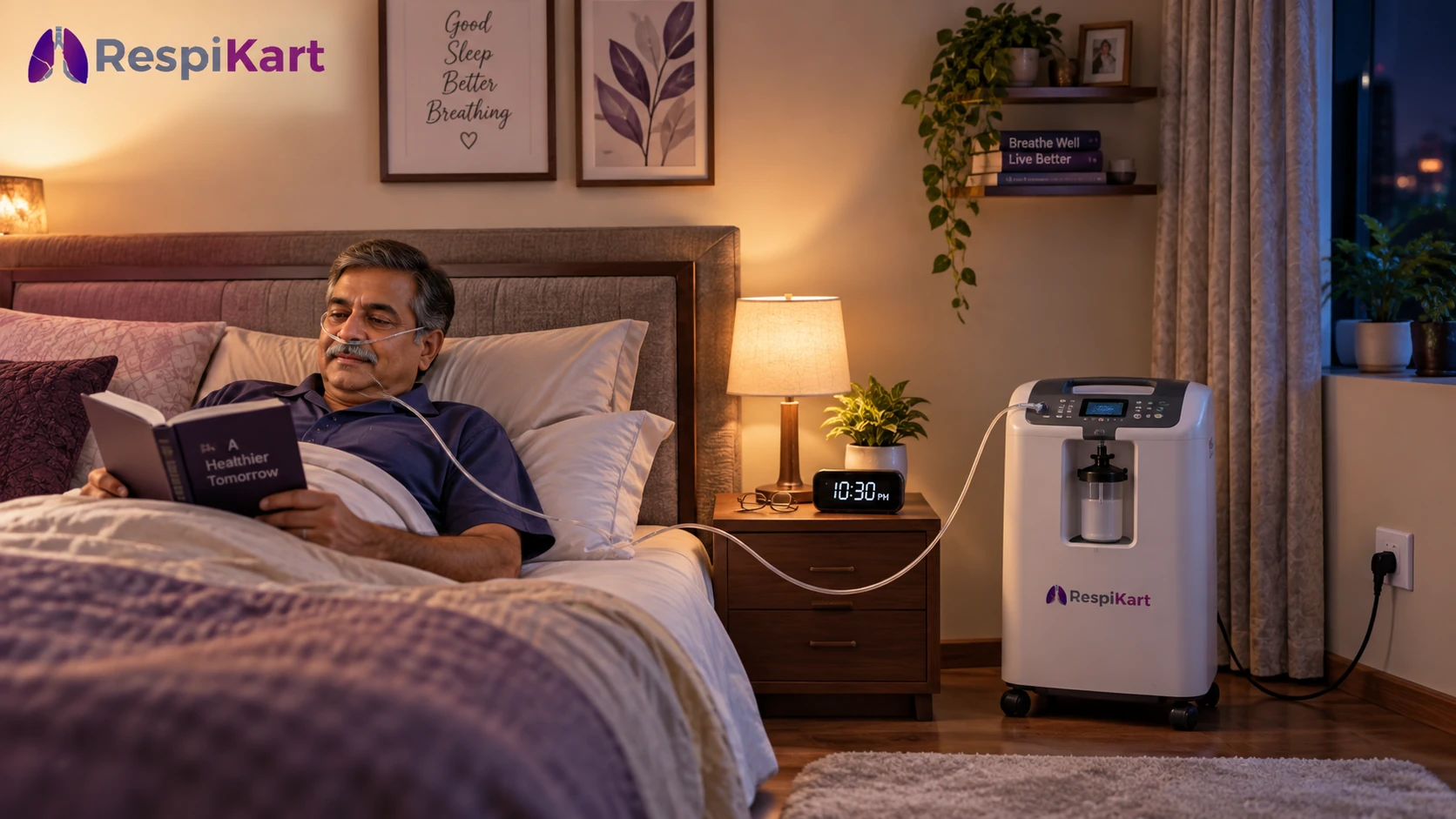
How to Set Up an Oxygen Concentrator Before Bed
Preparing the equipment before bedtime can help patients and caregivers avoid common problems during the night.
Place the concentrator in a suitable location
Keep the oxygen concentrator on a stable surface in an area with adequate airflow. The machine’s ventilation and air-intake openings should not be blocked.
Check the oxygen tubing
Make sure the tubing is properly connected and does not have sharp bends or kinks. Arrange excess tubing carefully so that it does not create a tripping or entanglement hazard.
Check the nasal cannula
Make sure the nasal cannula is positioned comfortably and connected correctly. If the cannula repeatedly comes out during sleep, discuss the problem with your healthcare provider.
Check the power connection
If your concentrator uses household electricity, check that the electrical connection is secure before going to sleep.
Keep the equipment away from flames
Oxygen supports combustion. Smoking, candles, incense, gas flames and other ignition sources should be kept away from oxygen equipment.
Should You Change the Oxygen Flow Rate at Night?
One of the most important principles of home oxygen therapy is to follow the prescribed oxygen flow.
Patients sometimes assume that if they feel uncomfortable or short of breath, increasing the flow will automatically solve the problem. That is not a safe assumption.
If your prescribed flow is a particular setting, use that setting unless your healthcare professional has provided specific instructions for changing it.
Never increase or decrease your prescribed oxygen flow simply because you feel better, worse or because another person is using a different setting.
If you believe your prescribed oxygen is no longer adequate, contact your healthcare professional.
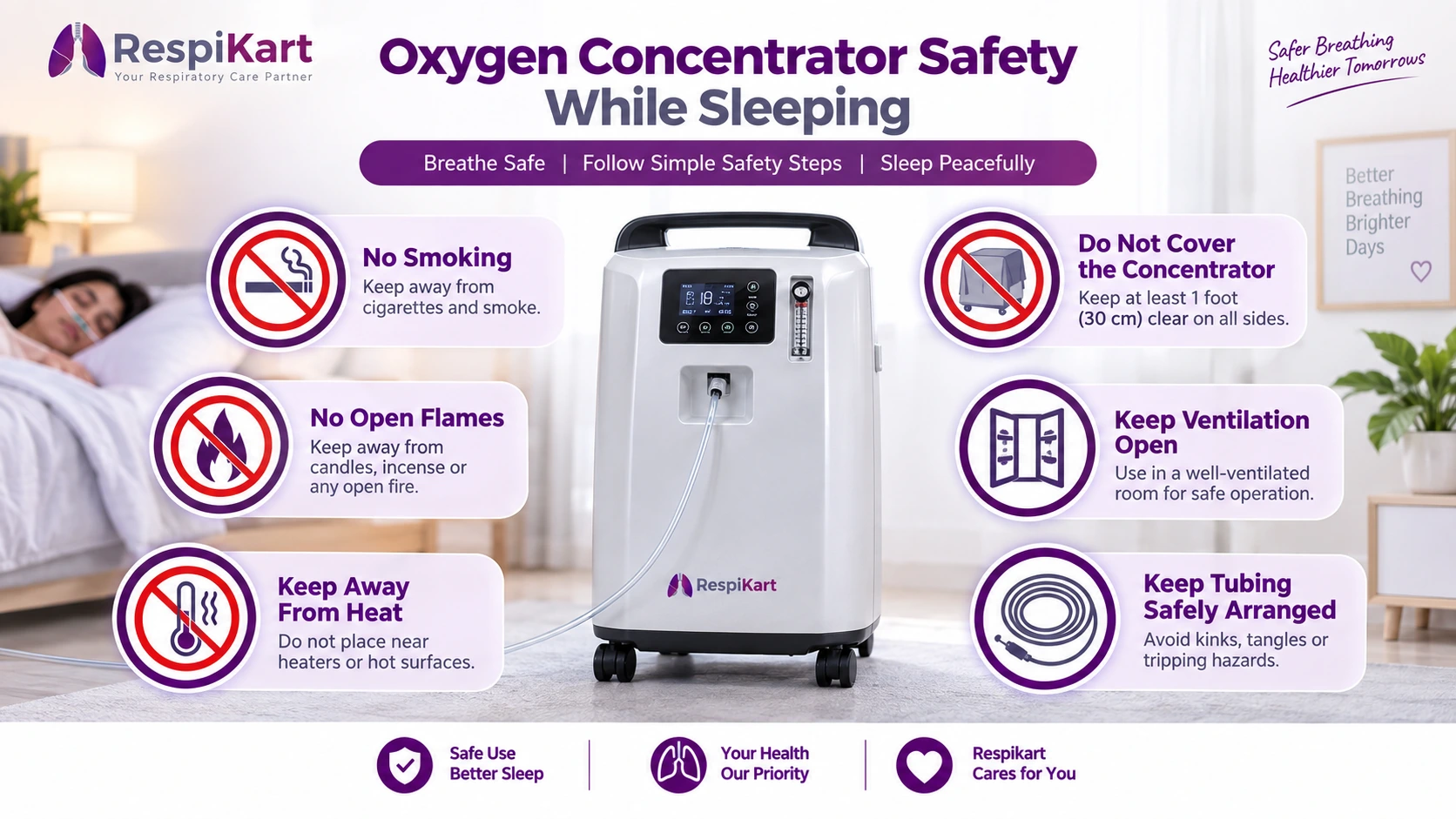
Oxygen Concentrator Safety While Sleeping
Oxygen therapy can be an important part of home care when prescribed, but oxygen-enriched environments can increase fire risk.
Patients and caregivers should make oxygen safety a routine part of the bedtime setup.
No Smoking
Do not smoke while using oxygen and do not allow smoking near oxygen equipment.
No Open Flames
Keep candles, incense, matches, gas flames and other ignition sources away from the oxygen setup.
Keep It Ventilated
Do not cover the oxygen concentrator with blankets, clothing or other materials.
Keep the Concentrator Away From Heat
The oxygen concentrator should be positioned away from heaters, radiators, direct heat sources and other potentially hazardous locations.
Do Not Cover the Machine
Covering the concentrator to reduce noise or protect it from dust can restrict airflow. The equipment should be operated according to the manufacturer’s instructions.
Keep Oxygen Tubing Safely Arranged
Oxygen tubing should be arranged so that the patient can move safely without becoming tangled in it.
Can You Sleep With an Oxygen Cannula?
When nighttime oxygen has been prescribed, a nasal cannula is commonly used to deliver oxygen while the patient sleeps.
The cannula should be positioned comfortably around the nose and ears, while the tubing should be arranged so that it does not become sharply bent or wrapped around the patient’s neck.
Some patients may initially experience dryness or irritation around the nose or ears.
If you experience persistent irritation, nosebleeds, skin damage or difficulty keeping the cannula in position, contact your healthcare provider for advice.
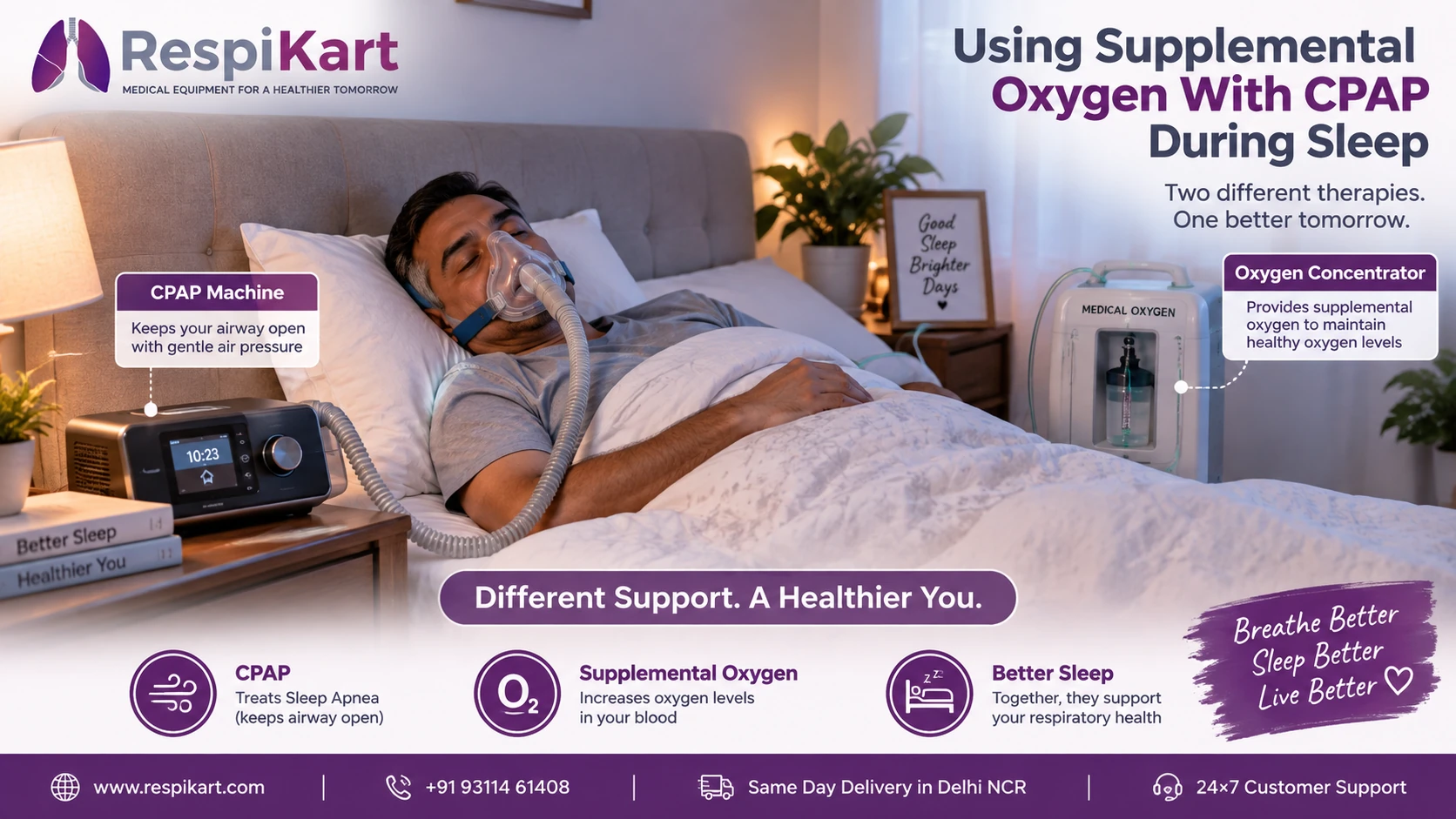
Can You Use an Oxygen Concentrator With CPAP?
Some patients use CPAP therapy and supplemental oxygen at the same time. These therapies serve different purposes.
CPAP provides positive airway pressure to help keep the airway open.
Supplemental oxygen increases the oxygen concentration delivered to the patient.
A healthcare professional may prescribe both therapies in some situations. If both have been prescribed for you, the equipment should be connected according to the manufacturer’s instructions and professional guidance.
The correct connection method and oxygen flow depend on the specific equipment and the patient’s prescribed therapy.
If you are researching CPAP equipment, visit Respikart’s CPAP Machine category .
Can You Sleep on Your Side While Using Oxygen?
Many patients can sleep in a comfortable position while using a nasal cannula.
Side sleeping may be comfortable for some patients, while others may prefer sleeping on their back or in another position.
Regardless of sleeping position, the tubing should remain safely arranged.
- Avoid sharply bending the oxygen tubing.
- Do not allow tubing to become wrapped around the neck.
- Avoid trapping tubing underneath the body.
- Keep excess tubing organized.
- Make sure the cannula remains correctly positioned.
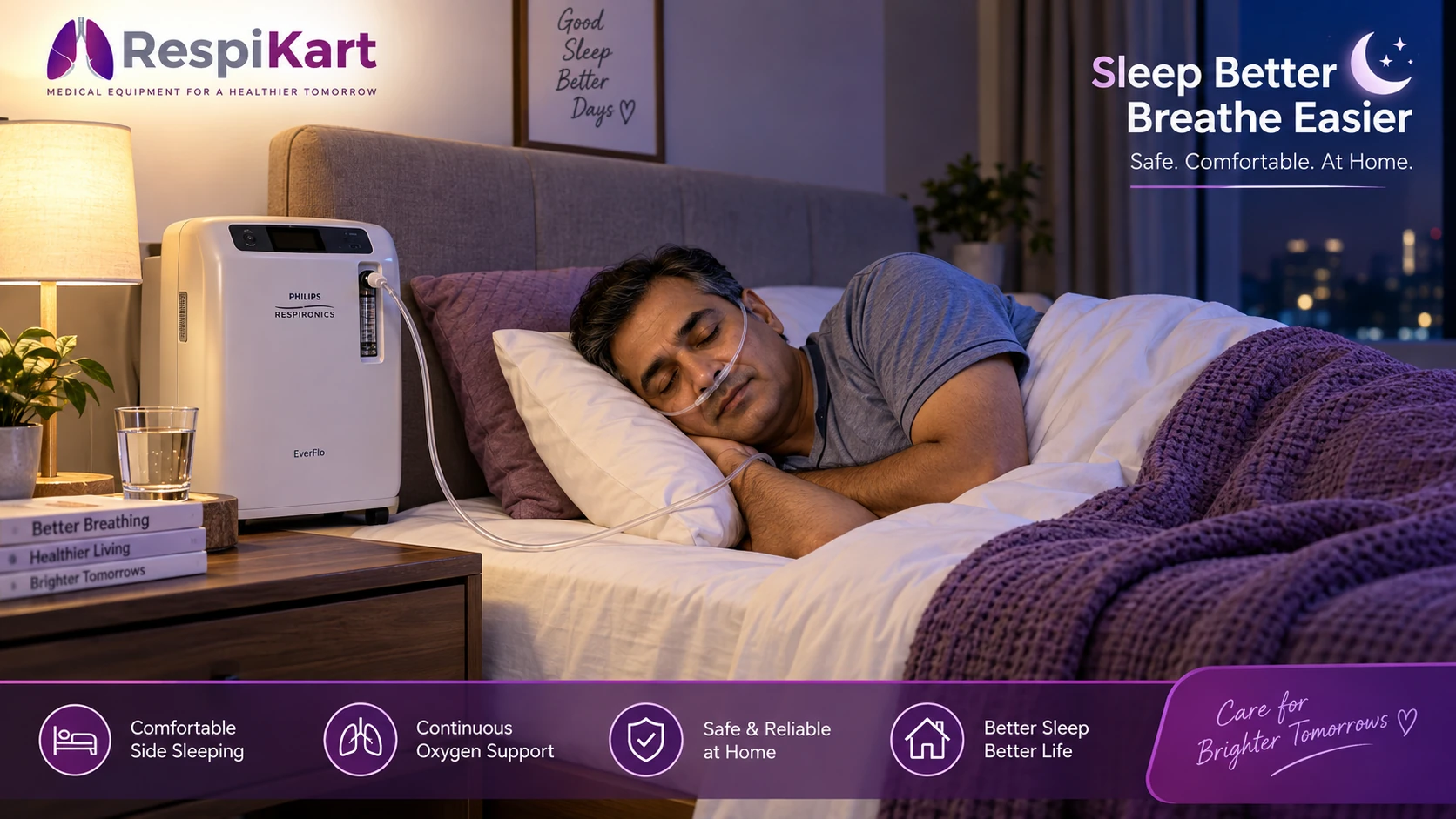
What Happens If the Oxygen Concentrator Makes Noise at Night?
Oxygen concentrators commonly produce some operating noise because the equipment contains components such as a compressor and fan.
If the sound is disturbing your sleep, do not put the machine inside a closed cupboard or cover it with blankets simply to reduce the noise.
Instead, position the machine in a suitable ventilated location where the oxygen tubing can still reach the patient comfortably.
If you notice an unusual new sound, repeated alarms or a noticeable change in the machine’s operation, consult the manufacturer’s instructions or contact your equipment provider.
What Happens If the Power Goes Out During the Night?
Many stationary oxygen concentrators depend on household electricity. Therefore, a power interruption can interrupt oxygen delivery.
If you depend on oxygen during sleep or continuously, ask your healthcare provider or oxygen equipment supplier about an appropriate backup plan.
Depending on the patient’s medical requirements, an appropriate backup oxygen arrangement may be considered.
Do not assume that any portable oxygen concentrator or oxygen cylinder will automatically be suitable as your backup. The backup system should be appropriate for your prescribed oxygen requirement.
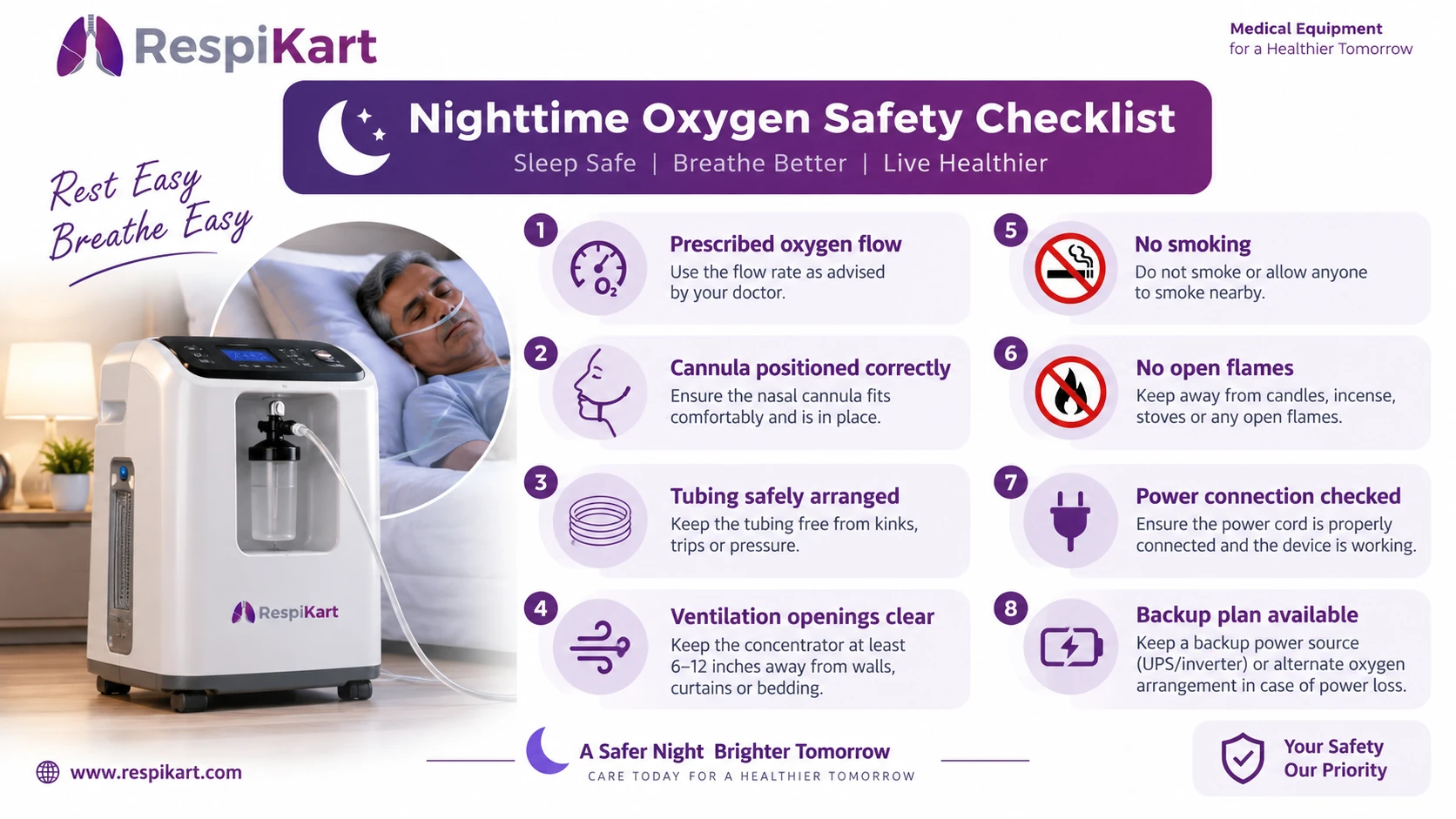
Nighttime Oxygen Safety Checklist
Common Mistakes to Avoid When Using an Oxygen Concentrator at Night
Mistake 1: Increasing the oxygen flow without medical advice
Patients should not assume that a higher oxygen flow is automatically better. Use the prescribed flow unless your healthcare professional has provided specific instructions.
Mistake 2: Covering the concentrator
Blankets, clothes and other objects should not block the concentrator’s airflow.
Mistake 3: Using oxygen near an open flame
Smoking, candles, incense and other ignition sources can create serious fire hazards around oxygen equipment.
Mistake 4: Ignoring alarms
If your concentrator produces an alarm, check the manufacturer’s instructions. If you cannot resolve the issue, contact the equipment provider.
Mistake 5: Not having a power-failure plan
Patients who depend on oxygen should discuss an appropriate contingency plan with their healthcare provider or oxygen supplier.
Mistake 6: Treating one pulse-oximeter reading as a reason to change oxygen
A pulse oximeter can provide oxygen saturation information, but a single reading does not independently determine whether supplemental oxygen is required or what flow rate should be used.
Oxygen Concentrator vs Oxygen Cylinder for Nighttime Use
Both oxygen concentrators and oxygen cylinders can be used to deliver supplemental oxygen when prescribed, but the way they provide oxygen is different.
| Feature | Oxygen Concentrator | Oxygen Cylinder |
|---|---|---|
| Oxygen source | Concentrates oxygen from surrounding room air. | Stores compressed oxygen. |
| Electricity | Usually requires electricity to operate. | Does not require electricity to deliver stored oxygen. |
| Refilling | Generally does not require refilling while powered and functioning. | Requires replacement or refilling when depleted. |
| Nighttime use | Can be used when nighttime oxygen is prescribed. | Can also be used when prescribed. |
| Power failure | Requires an appropriate backup plan if oxygen is essential. | Can deliver stored oxygen without mains electricity. |
| Portability | Depends on the model and design. | Depends on cylinder size and configuration. |
If you are looking for oxygen equipment for temporary home use in Delhi NCR, explore Respikart Medical Equipment Rentals .
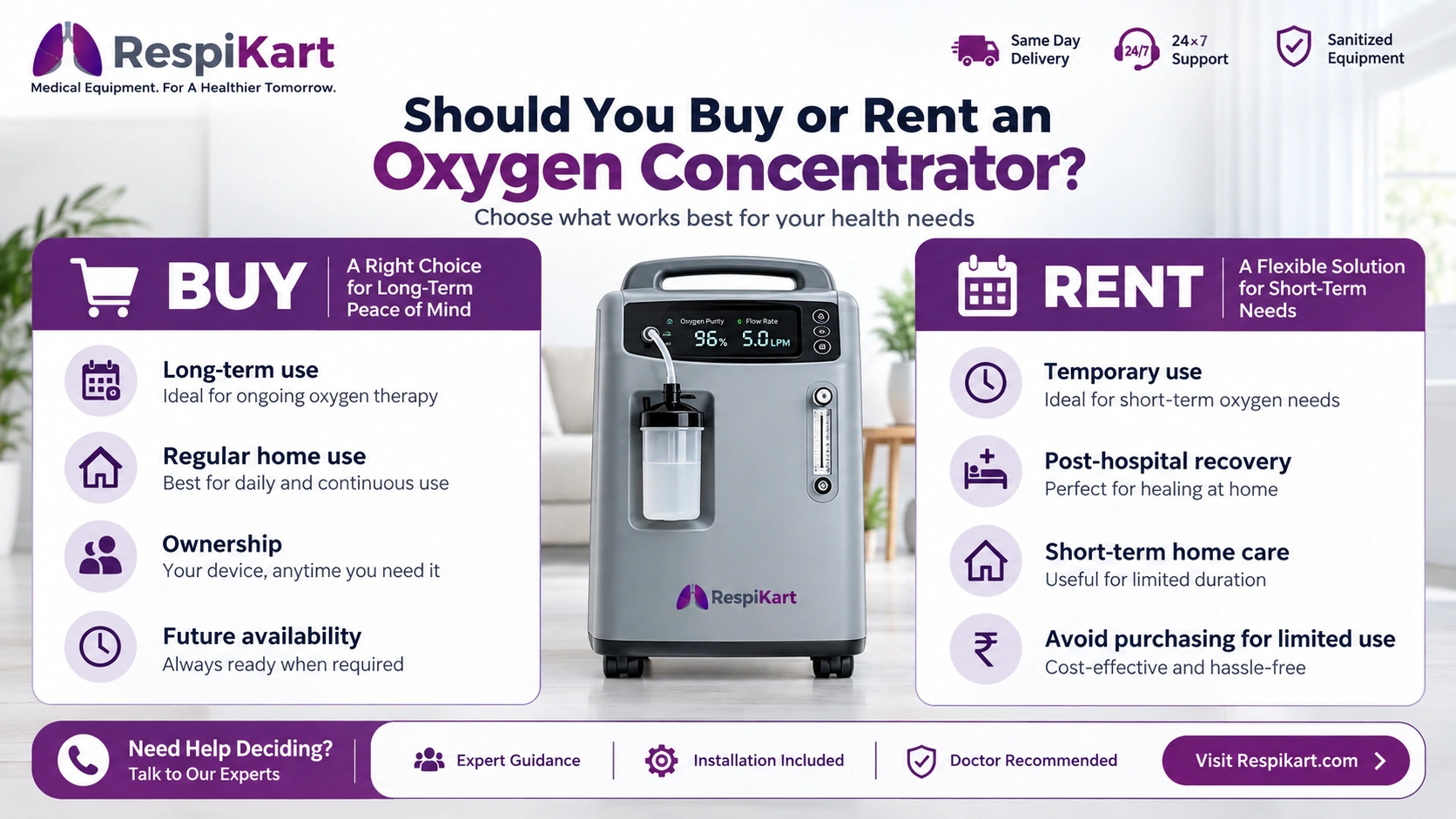
Should You Buy or Rent an Oxygen Concentrator?
Families often have to decide whether to purchase an oxygen concentrator or rent one. There is no single option that is right for every patient.
The decision can depend on how long the equipment is expected to be needed, the patient’s prescribed flow, whether the equipment is required only temporarily and the family’s preference for ownership versus short-term use.
Buying an Oxygen Concentrator May Be Considered When:
- Long-term oxygen therapy is expected.
- The equipment will be used regularly at home.
- You want to retain the equipment for future use.
- The selected machine meets the prescribed oxygen requirement.
Renting an Oxygen Concentrator May Be Considered When:
- Oxygen therapy is expected to be temporary.
- The patient is recovering at home after hospitalization.
- Equipment is required for short-term home care.
- The family does not want to purchase equipment for limited-duration use.
- A suitable rental option is available in the patient’s service area.
Looking for an Oxygen Concentrator on Rent in Delhi NCR?
Respikart provides medical equipment rental solutions for home-care requirements, including oxygen concentrators, subject to equipment availability and patient requirements.
If your doctor has prescribed home oxygen and you need a temporary oxygen concentrator, explore Respikart’s rental options.
View Medical Equipment Rentals Visit RespikartHow to Choose an Oxygen Concentrator for Home Use
Choosing an oxygen concentrator should begin with the patient’s prescribed oxygen requirement rather than with price or appearance alone.
1. Check the Prescribed Oxygen Flow
Different oxygen concentrators are designed for different flow ranges. First understand the flow prescribed by the healthcare professional.
2. Understand Continuous Flow and Pulse Dose
Some devices provide continuous-flow oxygen while some portable oxygen systems may provide pulse-dose delivery.
These modes are not automatically interchangeable for every patient.
3. Consider Where the Machine Will Be Used
Think about whether the equipment is required primarily for a bedroom, the entire home, travel or mobility.
4. Consider Power Requirements
A stationary concentrator may depend on household electricity. Consider your home power situation and whether a backup arrangement is required.
5. Consider Noise Level
If the concentrator will operate close to the bedroom, noise may be an important comfort consideration.
6. Consider Service and Technical Support
Medical equipment is not simply a product purchase. Proper setup, maintenance, troubleshooting and after-sales support can also matter.
Explore Respikart’s Oxygen Concentrator range when researching home oxygen equipment.
How to Maintain Your Oxygen Concentrator
Regular care can help keep your equipment clean and functioning according to the manufacturer’s instructions.
- Keep the exterior of the machine clean.
- Keep ventilation areas free from dust and obstruction.
- Clean or replace filters according to the manufacturer’s instructions.
- Inspect oxygen tubing regularly.
- Check the nasal cannula for wear or damage.
- Keep the machine in a clean and dry location.
- Follow the recommended servicing schedule.
If the concentrator is malfunctioning, do not open the internal components yourself. Contact the equipment supplier or an appropriately qualified service professional.
What Should Caregivers Check Before the Patient Sleeps?
Caregivers can use a simple routine before bedtime to make sure the patient’s oxygen setup is ready.
Check the following:
- Confirm the prescribed oxygen flow.
- Check that the cannula is correctly positioned.
- Check tubing connections.
- Make sure tubing is not kinked.
- Keep the concentrator ventilated.
- Keep smoking materials away.
- Keep candles and open flames away.
- Confirm the electrical connection.
- Know what to do if the machine alarms.
- Know the backup plan for a power failure if applicable.
What If the Patient Keeps Removing the Cannula During Sleep?
Some people may unconsciously move or remove their nasal cannula while sleeping.
If this happens occasionally, check whether the cannula and tubing are positioned comfortably and safely.
If it happens frequently, discuss the issue with the healthcare provider or oxygen equipment supplier.
Do not compensate for a repeatedly removed cannula by increasing the oxygen flow without medical advice.
Can Elderly Patients Sleep With an Oxygen Concentrator?
Older adults may use home oxygen when it has been prescribed for their medical requirements.
Caregivers may need to pay additional attention to tubing placement, fall hazards, fire safety, alarms, electrical supply and the patient’s ability to manage the equipment.
If the patient has difficulty understanding or operating the equipment, a caregiver should receive appropriate instructions from the healthcare professional or equipment provider.
Does Oxygen Therapy Cure the Underlying Disease?
No. Supplemental oxygen is a therapy used to provide additional oxygen when it is medically indicated. It does not necessarily cure the condition responsible for low oxygen levels.
The underlying condition may require its own treatment plan, which could include medicines, respiratory support, rehabilitation or other therapies depending on the diagnosis.
Oxygen therapy should therefore be considered as one part of an individual’s overall medical care when prescribed.
Should You Monitor Oxygen Saturation While Sleeping?
Whether you should monitor oxygen saturation at home depends on your individual medical situation and your healthcare professional’s advice.
Some patients may be advised to use a pulse oximeter, while others may undergo overnight oxygen monitoring or a sleep study.
Pulse-oximeter readings can sometimes be affected by movement, cold fingers, poor circulation, incorrect sensor positioning and other factors.
Therefore, a single reading should not automatically be used as a reason to change prescribed oxygen therapy.
When Should You Contact Your Doctor?
Contact your healthcare provider if your breathing changes significantly, if prescribed oxygen becomes difficult to tolerate or if you have concerns about your oxygen therapy.
Seek urgent medical attention for severe or sudden symptoms such as:
- Severe difficulty breathing
- Blue or grey lips or face
- Severe chest pain
- Confusion or unusual drowsiness
- Fainting
- Sudden significant deterioration
If you experience severe or sudden breathing difficulty or another medical emergency, seek urgent medical attention rather than relying on changes to your oxygen concentrator settings.
Need Home Oxygen Equipment?
Respikart offers medical equipment solutions for home respiratory care, including oxygen concentrators available for purchase and rental, depending on equipment availability and patient requirements.
If you have been advised to use oxygen at home, choose equipment based on your prescribed oxygen requirement and take professional guidance when setting up your therapy.
Explore Oxygen Concentrators Oxygen Equipment on RentFrequently Asked Questions About Sleeping With an Oxygen Concentrator
Can I sleep with an oxygen concentrator every night?
If nighttime oxygen has been prescribed by your healthcare professional, you may be instructed to use an oxygen concentrator every night. Follow the prescribed flow and duration.
Can I use an oxygen concentrator without a prescription?
Oxygen therapy should not be self-prescribed. A healthcare professional should determine whether supplemental oxygen is appropriate and what flow and duration are required.
Can I sleep with an oxygen concentrator beside my bed?
A concentrator can be placed in a suitable location near the patient when nighttime oxygen is prescribed. Ensure the machine has adequate ventilation and follow the manufacturer’s placement instructions.
Can I sleep on my side while using oxygen?
Many patients can sleep on their side while using a nasal cannula. Make sure the oxygen tubing remains safely positioned and is not kinked or wrapped around the neck.
Can I use oxygen with CPAP?
Some patients are prescribed both CPAP and supplemental oxygen. If both therapies have been prescribed for you, follow professional and manufacturer instructions for connecting the equipment.
Can I increase oxygen flow if I feel breathless at night?
Do not change the prescribed oxygen flow without appropriate medical instructions. If your breathing suddenly worsens, seek appropriate medical attention.
Is it dangerous to smoke near an oxygen concentrator?
Yes. Smoking and open flames are serious fire hazards around oxygen equipment. Keep smoking materials and ignition sources away from the oxygen setup.
Does an oxygen concentrator need ventilation?
Yes. Keep ventilation openings unobstructed and do not cover the concentrator while it is operating.
What should I do if the oxygen concentrator stops during a power cut?
If you depend on oxygen, follow the backup plan provided by your healthcare provider or oxygen supplier. Discuss an appropriate backup oxygen arrangement before you need it.
Can I rent an oxygen concentrator for temporary home use?
Rental may be an option for patients who need oxygen equipment temporarily, subject to medical requirements, equipment availability and service area.
Visit Respikart Rentals to explore available medical equipment rental solutions.
Conclusion: Can You Sleep While Using an Oxygen Concentrator?
For patients who have been prescribed nighttime oxygen therapy, sleeping while using an oxygen concentrator can be part of a normal home oxygen routine.
The most important thing is to use the equipment according to the prescribed treatment plan.
Patients should use the prescribed oxygen flow, keep the concentrator properly ventilated, arrange oxygen tubing safely and maintain strict fire-safety precautions.
If you are unsure whether you need oxygen while sleeping, how much oxygen you need or which type of oxygen concentrator is appropriate, speak with your doctor or qualified respiratory-care professional.
For patients and families looking for home oxygen equipment, Respikart provides medical equipment solutions including oxygen concentrators for purchase and rental, depending on requirements and availability.
Explore More Respiratory Care Resources at Respikart
Looking for related medical equipment or respiratory-care information? Explore the following Respikart sections:
This article is provided for general educational and informational purposes only. It does not replace medical advice, diagnosis or treatment from a qualified healthcare professional.
Oxygen therapy should be started, stopped or adjusted only according to appropriate medical advice and the individual’s prescribed clinical requirements.
If you experience severe or sudden breathing difficulty, severe chest pain, confusion, fainting, blue or grey lips or face, or another medical emergency, seek immediate medical attention.
