
CPAP MACHINE
BMC G3 A20 vs ResMed AirSense 11 AutoSet Tripack 4G: Which Auto CPAP Machine Is Better?
Choosing a CPAP machine is one of those decisions that feels bigger than it should, mostly because it is. Once a sleep study confirms obstructive sleep apnea, the machine you pick becomes something you’ll rely on every single night, so it’s worth taking the time to actually understand what you’re paying for, rather than choosing based on brand recognition or whichever option a salesperson pushes hardest.
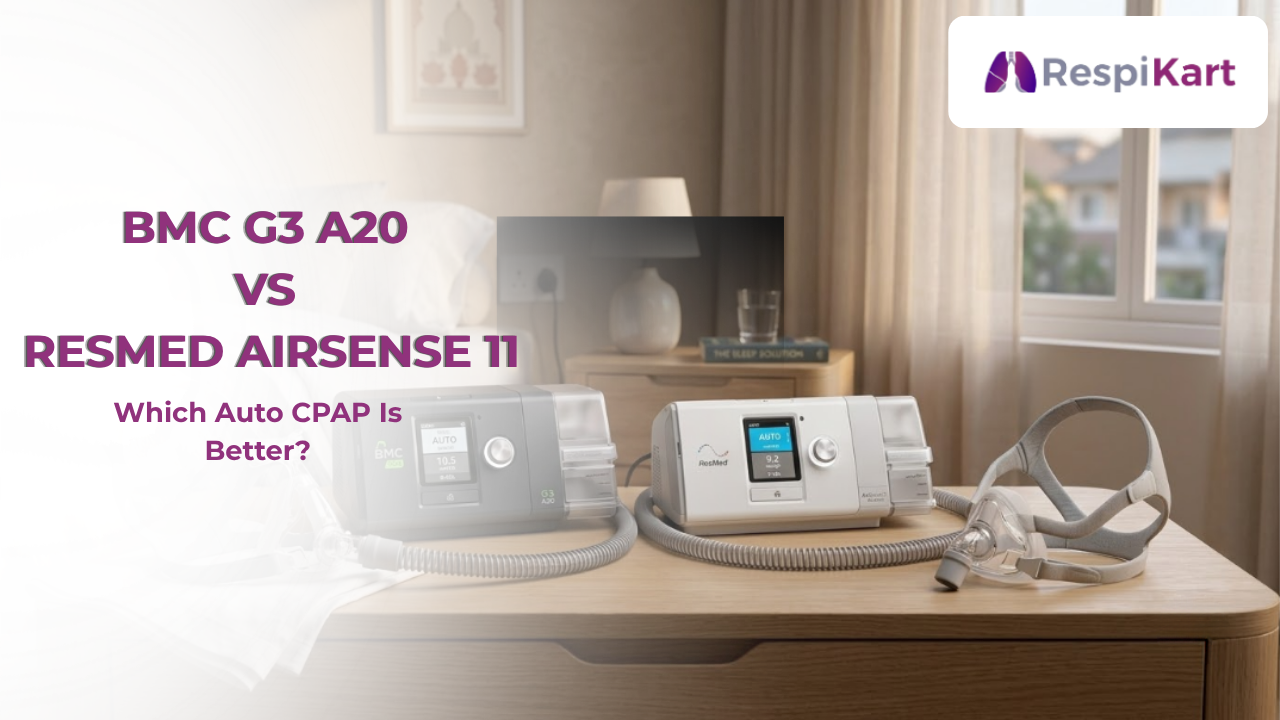
Two machines that come up often in that search are BMC’s G3 A20 and ResMed’s AirSense 11 AutoSet Tripack 4G. Both are auto-adjusting CPAP machines, but they come from very different price brackets. On RespiKart, the BMC G3 A20 is listed at ₹31,000, while the ResMed AirSense 11 AutoSet Tripack 4G is listed at ₹75,000, discounted from ₹1,00,000. That’s a gap of well over ₹40,000, and understanding what that gap actually buys is the whole point of this comparison.
What an auto CPAP actually does
Both machines fall into the auto-adjusting CPAP category, sometimes called APAP. Rather than delivering one fixed pressure all night, the device continuously reads breathing patterns and adjusts pressure up or down in real time, aiming to deliver the lowest pressure that still keeps the airway open. That responsiveness is what separates an auto CPAP from a basic fixed-pressure machine, and both the G3 A20 and the AirSense 11 are built around this idea.
This matters because sleep apnea severity isn’t constant throughout the night. Pressure needs can shift depending on sleep stage, sleeping position, alcohol intake the night before, nasal congestion, and even how tired someone is. A fixed-pressure machine can’t respond to any of that. An auto CPAP continuously recalculates what pressure is actually needed at that moment, which is generally more comfortable and, for many patients, more effective than sitting at one static setting all night regardless of what the body needs.
Both machines here work within a doctor-prescribed pressure range, typically 4 to 20 cmH2O, and adjust within that boundary automatically. Neither one lets the user set pressure arbitrarily outside clinical guidance, which is exactly how it should work.
Side-by-side specification comparison
| Specification | BMC G3 A20 | ResMed AirSense 11 AutoSet Tripack 4G |
|---|---|---|
| RespiKart price | ₹31,000 | ₹75,000 (down from ₹1,00,000) |
| Device type | Auto CPAP (APAP) | Auto CPAP (APAP) |
| Pressure range | 4–20 cmH2O | 4–20 cmH2O |
| Pressure accuracy | ±0.5 cmH2O | Not separately listed |
| Exhalation relief | RESlex (Level 1–3) | EPR (Expiratory Pressure Relief) |
| Ramp feature | Auto Ramp, 0–60 min | AutoRamp with sleep onset detection |
| Humidifier | Integrated, heated, with pre-heat function | Integrated, heated |
| Connectivity | SD card data storage | Built-in 4G cellular, myAir app compatible |
| Display | 3.5 inch color LCD | Color touchscreen |
| Noise level | Below 28 dB | Around 27 dBA |
| Mask leak compensation | Automatic | Automatic (via AutoSet algorithm) |
| Weight | Approx. 1.7 kg | Approx. 1.13 kg |
| Warranty | 1 year | 2 years |
That table captures the specs, but specs alone don’t tell you which machine will actually suit a specific person’s routine, budget, and comfort with technology. The rest of this comparison digs into what those numbers mean in daily use.
What the BMC G3 A20 brings to the table
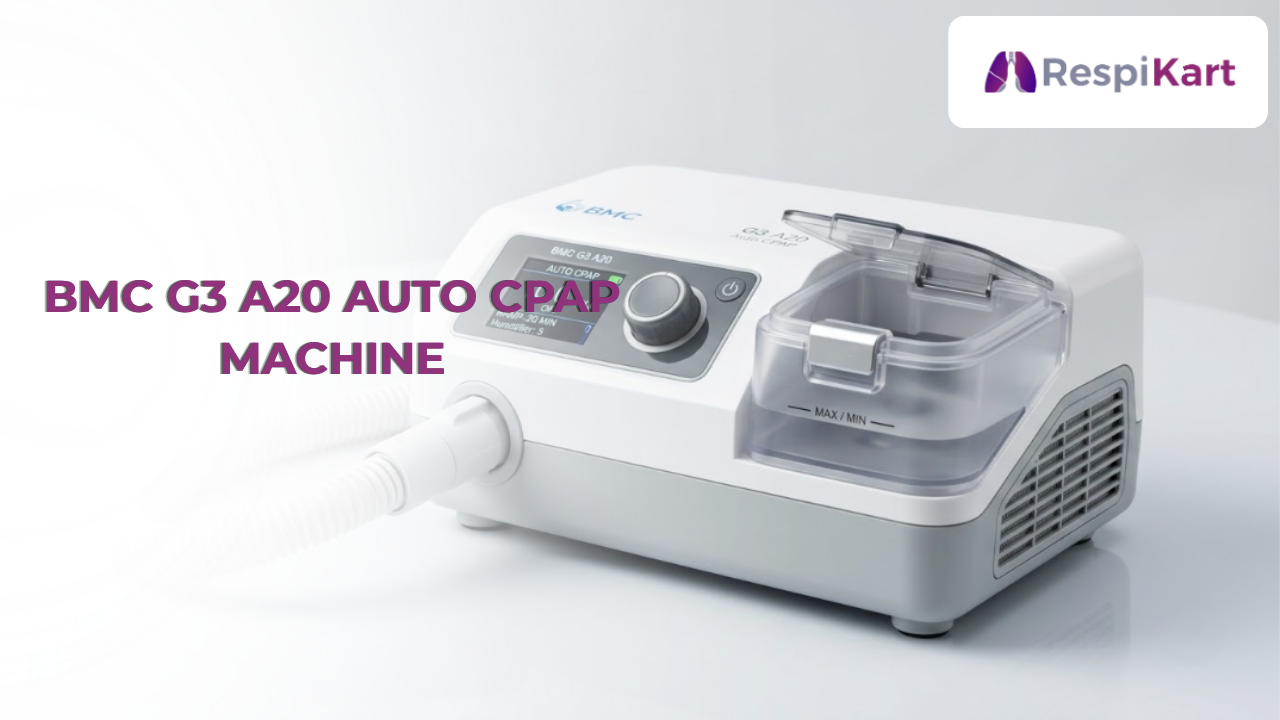
The G3 A20 is BMC’s flagship auto CPAP, and it’s built to cover the essentials well without pushing the price too high. It automatically adjusts pressure between 4 and 20 cmH2O, includes RESlex exhalation relief to make breathing out feel more natural, and comes with Auto Ramp so pressure starts low and increases gradually as you fall asleep. The humidifier is integrated and heated, with a pre-heat function that warms the water before you even start your session, which is a small but genuinely useful touch on cold nights when climbing into bed and immediately breathing cool, damp air can be an unpleasant way to start therapy.
Data tracking works through an SD card rather than built-in connectivity, so reviewing your sleep therapy data means pulling the card and loading it into BMC’s RESmart software on a computer, or using their mobile app for QR-based access. It’s not as seamless as a fully connected machine, but it gets the job done, and for many patients, especially those who just need to periodically share reports with their doctor every few months, that’s more than sufficient. The extra step of physically removing a card and transferring data isn’t a dealbreaker for most people, though it does mean therapy compliance data isn’t instantly available the way it would be with a connected device.
The G3 A20’s mask leak compensation adjusts automatically when it detects air escaping around the mask seal, which helps maintain effective pressure delivery even when a mask isn’t perfectly sealed, something that happens more often than people expect, especially early in CPAP use before finding the right mask fit.
At ₹31,000, it lands in a comfortable mid-range spot, offering serious auto CPAP functionality without stretching into premium territory. For many first-time users, or for anyone replacing an older, simpler CPAP machine, this represents a solid step up in comfort and automation without a dramatic jump in cost.
What the ResMed AirSense 11 AutoSet Tripack 4G brings to the table
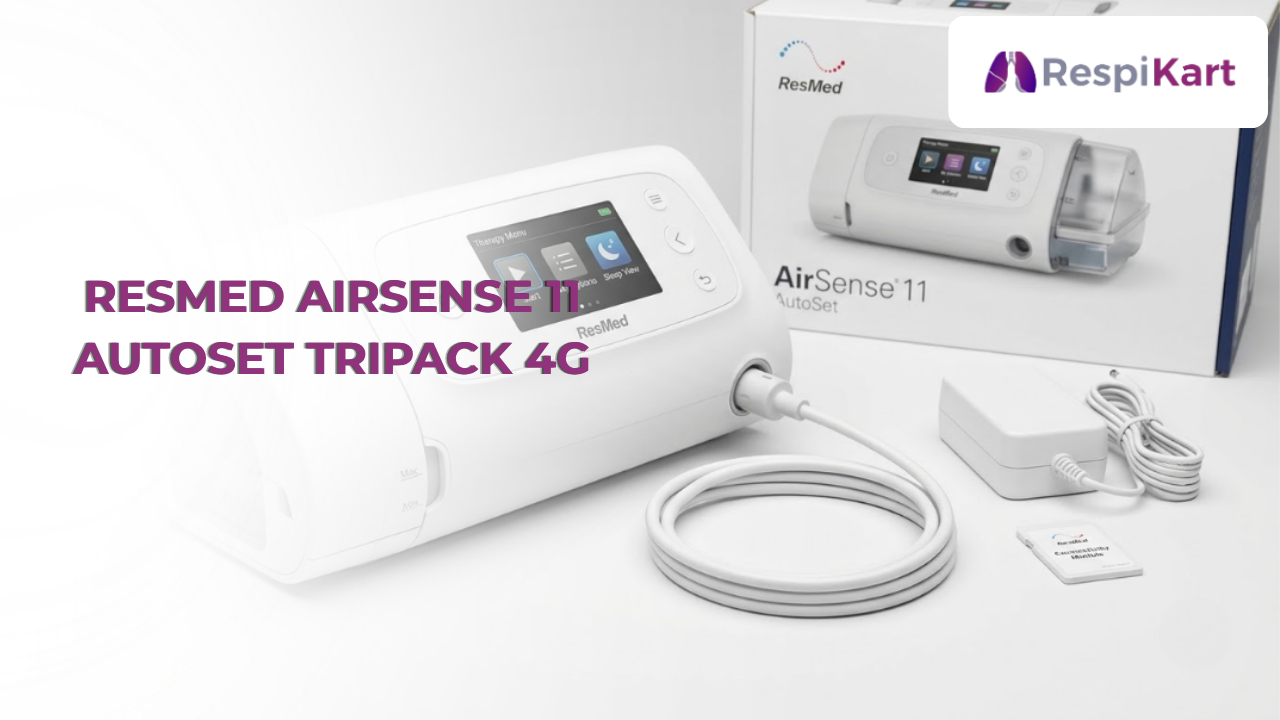
ResMed’s AirSense 11 sits at a noticeably higher price point, and the difference shows up mainly in connectivity, refinement, and long-term support infrastructure rather than in the core therapy mechanics. Both machines cover the same 4 to 20 cmH2O pressure range, so the fundamental therapy capability is comparable. What the AirSense 11 adds is built-in 4G cellular connectivity, meaning your therapy data uploads automatically to the cloud without needing an SD card or manual transfer of any kind.
That connectivity pairs with the myAir app, which gives patients a daily sleep score, personalized coaching tips, and guided setup support through what ResMed calls a Personal Therapy Assistant. For someone new to CPAP therapy who wants hand-holding through the adjustment period, or for a doctor who wants remote visibility into compliance data without waiting for the patient to bring in a memory card, this is a genuinely meaningful advantage. The app format also tends to make data feel more approachable to patients who aren’t particularly technical, since a daily score and simple charts are easier to interpret than raw usage logs.
The AirSense 11 also uses EPR, ResMed’s version of exhalation pressure relief, alongside AutoRamp with sleep onset detection, which is a more refined version of the ramp concept, since it specifically detects when you’ve fallen asleep before increasing pressure, rather than running on a simple timer. This distinction matters more than it might seem. A timer-based ramp increases pressure after a fixed number of minutes regardless of whether the person is actually asleep yet, which can occasionally mean therapy pressure ramps up while someone is still awake and trying to settle in. Sleep onset detection avoids that mismatch by waiting for an actual signal that sleep has begun.
The touchscreen interface and slightly lower noise rating round out a machine that feels more polished in daily use. ResMed has also built out additional features like Care Check-In, which offers periodic coaching prompts tailored to how therapy is progressing, and over-the-air software updates, meaning the device can receive feature or maintenance updates without needing a service visit.
The Tripack designation refers to the bundle itself, which typically includes the AirSense 11 device, the HumidAir 11 water tub, ClimateLineAir 11 heated tubing, a standard filter, power adapter, and travel bag, essentially a more complete out-of-box package compared to a bare unit. Heated tubing specifically helps reduce condensation buildup inside the hose, sometimes called rainout, which can otherwise create an uncomfortable gurgling sound or occasional water droplets reaching the mask.
Where the price difference actually goes
It’s tempting to assume a machine costing more than double another must be proportionally more effective at treating sleep apnea, but that’s not quite how it works. Both machines cover the same pressure range and rely on automatic algorithms to adjust therapy through the night. The core function, keeping the airway open at the lowest necessary pressure, is comparable between them.
The extra cost of the AirSense 11 buys connectivity, app-based coaching, a longer warranty, heated tubing included in the bundle, and ResMed’s broader support ecosystem, rather than a fundamentally different therapy mechanism. For some patients, particularly those managing sleep apnea long-term or those who want remote monitoring shared with their doctor, that’s worth paying for. For others who just need reliable, effective therapy without the extras, it may not be.
It’s worth being honest about this because CPAP shopping can sometimes feel like the more expensive option must automatically be the “correct” medical choice, when in reality both devices are capable of delivering effective, clinically appropriate therapy within the same pressure parameters. The decision is more about lifestyle fit than medical superiority.
Who should consider the BMC G3 A20
The G3 A20 makes sense for patients who want solid, dependable auto CPAP therapy without paying for cloud connectivity they may not use. It’s a good fit for first-time CPAP users on a moderate budget, for patients who are comfortable occasionally transferring data via SD card, and for anyone who wants the core comfort features, heated humidification, exhalation relief, and auto ramp, without needing an app-based coaching layer.
It also suits patients who are simply more comfortable with a straightforward device that does its job without asking them to install an app, create an account, or manage a smartphone connection alongside their therapy. Some people genuinely prefer a device that just runs quietly in the background without any digital layer attached to it.
Who should consider the ResMed AirSense 11 AutoSet Tripack 4G
The AirSense 11 is the stronger choice for patients who want built-in connectivity and don’t want to think about manual data transfer at all. It suits people who value guided onboarding through an app, especially those newer to therapy who benefit from daily feedback and coaching during the adjustment period, which for many people is the hardest part of starting CPAP.
It’s also a sensible pick for anyone whose doctor wants remote access to compliance data, since the 4G connectivity handles that automatically in the background, which can be particularly useful during the first few months of therapy when adherence tracking often determines things like insurance reimbursement or ongoing prescription support in some healthcare systems. The longer two-year warranty adds a bit of extra peace of mind as well, and the included heated tubing in the Tripack bundle is a comfort feature that would otherwise need to be purchased separately with many other machines.
Noise, comfort, and daily use
Both machines are quiet by CPAP standards, with the BMC G3 A20 rated below 28 dB and the AirSense 11 around 27 dBA. In practice, that one-decibel difference isn’t something most users would notice, and both are designed to run quietly enough that a bed partner shouldn’t be disturbed, assuming the mask is fitted properly and the tubing is connected securely, since leaks are usually a bigger source of noise than the machine itself.
Comfort-wise, both include heated humidification and some form of exhalation pressure relief, which are the two features that matter most for reducing the dryness and the “fighting the machine” sensation that puts many new users off CPAP therapy early on. The G3 A20’s pre-heat function is a nice practical touch, and the AirSense 11’s AutoRamp with sleep onset detection is arguably a slightly smarter take on the same underlying idea of easing you into pressure gradually.
Mask compatibility is worth mentioning too, since neither machine locks a user into a specific mask brand. Both are designed to work with standard CPAP mask types, whether nasal, nasal pillow, or full face, so the choice of machine doesn’t need to dictate mask choice, and vice versa. That said, ResMed’s own masks are specifically designed and marketed alongside the AirSense 11 with claimed synergy in fit-check features, though third-party masks work perfectly well with either device.
Warranty and long-term reliability
The BMC G3 A20 comes with a 1-year manufacturer warranty, while the AirSense 11 AutoSet Tripack 4G comes with 2 years. Given that a CPAP machine typically runs every single night for years, that extra year of coverage on the ResMed unit is a real, tangible benefit, not just a marketing detail. A CPAP machine that runs eight hours a night accumulates roughly 2,900 hours of use per year, which is a meaningful amount of continuous motor and electronic operation, so warranty length genuinely matters for peace of mind over the life of the device.
Both warranties cover manufacturing defects under normal use, and both exclude consumables like filters, tubing, masks, and humidifier chambers, which is standard across the industry and something worth budgeting for separately regardless of which machine you choose. Filters in particular need periodic replacement, usually every few weeks to a couple of months depending on air quality and usage, and this is a recurring cost that applies to both machines equally.
A note on medical guidance
Neither of these machines should be purchased or adjusted without a proper diagnosis and prescription. Auto CPAP therapy works within a pressure range set based on a sleep study, and while both devices adjust automatically within that range, the range itself, along with mask type and any additional settings, should come from a sleep physician. If you’re switching from one machine to another, it’s worth confirming with your doctor whether any settings need to be reconfirmed on the new device, since even though both machines work within similar pressure ranges, the underlying algorithms that determine how quickly and how much pressure adjusts can differ slightly between manufacturers.
It’s also worth mentioning that neither BMC nor ResMed markets these devices for self-diagnosis or unsupervised pressure adjustment. Auto CPAP machines are prescription medical devices, and buying one without a sleep study and clinical guidance skips a step that genuinely matters for both safety and effectiveness.
Common mistakes people make when choosing between these two
One frequent mistake is assuming connectivity features are essential when, for a lot of patients, they simply aren’t. If a patient isn’t particularly interested in daily sleep scores or app-based coaching, and is fine handing a doctor an SD card every few months, the G3 A20 covers the actual medical need just as well, at less than half the price.
Another common mistake works the other way. Some buyers choose the cheaper option purely on cost and later find themselves frustrated by the extra manual steps involved in data transfer, particularly if they’re the type of person who wants immediate feedback on how their therapy is going. If daily engagement with therapy data is genuinely motivating for someone, and it is for many people early in CPAP use, that’s a legitimate reason to pay more for the connected experience.
A third mistake is not accounting for the cost of consumables and accessories over time. Both machines need periodic filter replacement, and eventually mask and tubing replacement as well. Factoring in these ongoing costs, rather than focusing purely on the upfront machine price, gives a more accurate picture of total cost over a few years of use.
Final take
Both the BMC G3 A20 and the ResMed AirSense 11 AutoSet Tripack 4G are capable auto CPAP machines that deliver the same core pressure range and comparable comfort features. The real difference is in what surrounds that core function. The G3 A20 offers dependable, well-rounded therapy at a moderate price, while the AirSense 11 adds built-in connectivity, app-based coaching, a longer warranty, heated tubing, and a more complete accessory bundle, at a cost that reflects all of that added infrastructure.
If budget is a primary concern and you’re comfortable with SD card data transfer, the G3 A20 delivers strong value and covers the essential medical need without compromise. If you want the convenience of automatic cloud-based tracking, guided app support, and a longer warranty, and the price difference isn’t a barrier, the AirSense 11 Tripack 4G is the more complete package. Either way, the right choice comes down to matching the machine to how you’ll actually use it night after night, not just which one has the longer feature list on paper, and neither purchase should skip the step of a proper sleep study and prescription from a qualified physician.
FAQs
What’s the price difference between the BMC G3 A20 and the ResMed AirSense 11 AutoSet Tripack 4G?
Do both machines cover the same pressure range?
Which machine has better connectivity?
Which machine is quieter?
What’s included in the ResMed Tripack bundle?
Which machine offers a longer warranty?
Is one machine more effective at treating sleep apnea than the other?
Do I need a prescription to buy either of these machines?
How often do I need to replace filters and other consumables?
Explore These Auto CPAP Machines at RespiKart
Compare the ResMed AirSense 11 AutoSet Tripack 4G and BMC G3 A20 Auto CPAP Machine based on your prescribed therapy, comfort preferences and budget.
