

Uncategorized
How to Choose the Right Patient Monitor for ICU & Hospital Use
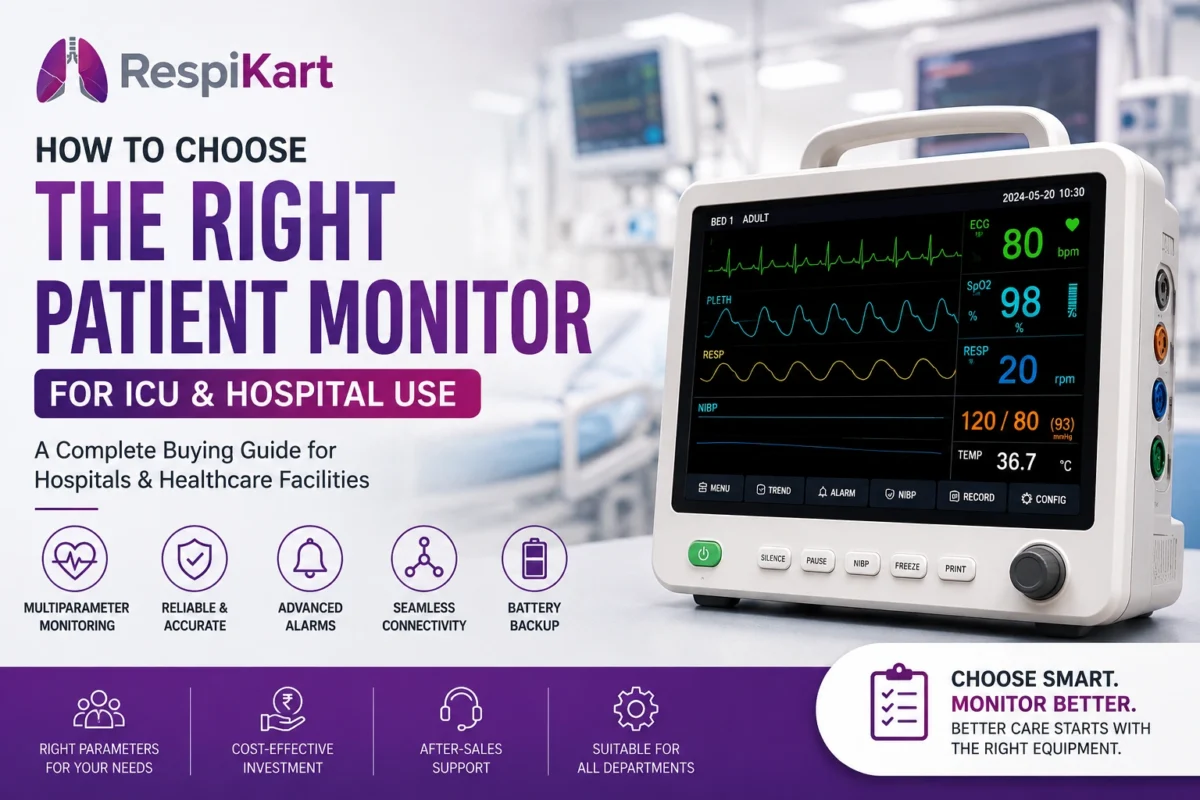
How to Choose the Right Patient Monitor for ICU & Hospital Use
A practical buying guide for hospitals, ICUs, emergency departments, operation theatres, clinics and healthcare facilities looking for the right patient monitoring solution.
The right monitor starts with the right clinical requirement
Selecting a patient monitor for a hospital or ICU is an important equipment decision. The monitor needs to provide reliable information, be easy for clinical staff to operate and match the type of patients being treated.
Different patients and clinical environments require different levels of monitoring. A basic monitor may be sufficient for some wards, while an ICU may require a more advanced multiparameter monitor with ECG analysis, SpO₂, NIBP, respiration, temperature and additional parameters such as IBP or EtCO₂.
With many patient monitors available in India, hospitals may find it difficult to determine whether they need a basic 3-parameter monitor, a 5-parameter monitor or an advanced multiparameter system.
What should you focus on?
Don’t select a patient monitor only by price or the number of features. Consider the clinical application, patient population, monitoring parameters, display, alarms, connectivity, accessories, service support and future requirements.
What Does a Patient Monitor Do?
A patient monitor measures and displays selected physiological parameters of a patient. Depending on the model and configuration, it can display numerical values and waveforms for several vital parameters.
ECG & Heart Rate
Displays cardiac electrical activity and heart rate. Depending on the model, ECG functionality may include waveform, rhythm, arrhythmia and ST-segment information.
SpO₂
Measures peripheral oxygen saturation and pulse rate. Sensor compatibility and availability should be considered when selecting a monitor.
NIBP
Non-invasive blood pressure monitoring can provide manual or automatic measurements depending on the monitor configuration.
Respiration
Provides information about respiratory rate and is commonly available through ECG-based respiration measurement.
Temperature
Temperature monitoring can help healthcare professionals observe changes in body temperature. Some models support dual temperature channels.
Advanced Parameters
Selected advanced monitors may support IBP, EtCO₂, advanced ECG analysis, arrhythmia detection, ST analysis and connectivity.
Why Choosing the Right Patient Monitor Matters
Monitoring requirements are not the same for every department or patient. The equipment should match the intended clinical environment.
Basic bedside monitoring
Depending on the patient’s condition, basic monitoring of SpO₂, pulse and blood pressure may be sufficient.
Fast patient assessment
ECG, SpO₂, NIBP and respiration monitoring may be appropriate where patients require rapid assessment.
Continuous critical monitoring
Critically ill patients may require multiple waveforms, ECG analysis, temperature and additional parameters.
Procedure-focused monitoring
Monitoring may need to include several vital parameters and appropriate alarm functionality according to the clinical workflow.
Remember: The best patient monitor is not necessarily the most expensive one. The right choice is the monitor that provides the required parameters, functionality and reliability for the intended clinical application.
3-Parameter vs 5-Parameter vs Advanced Patient Monitor
Understanding the difference between monitor categories can make hospital procurement decisions much easier.
3-Parameter
For essential monitoring requirements
- ✓ ECG / Heart Rate
- ✓ SpO₂
- ✓ NIBP
- ✓ Suitable for selected basic applications
- ✓ Generally simpler configuration
5-Parameter
For broader bedside monitoring
- ✓ ECG
- ✓ SpO₂
- ✓ NIBP
- ✓ Respiration
- ✓ Temperature
Advanced Multiparameter
For higher-acuity requirements
- ✓ ECG & advanced analysis
- ✓ SpO₂
- ✓ NIBP
- ✓ IBP on supported models
- ✓ EtCO₂ on supported models
- ✓ Connectivity options
11 Things to Check Before Buying a Patient Monitor
A good purchasing decision should look beyond the product price. Evaluate the monitor according to your actual clinical and operational requirements.
Clinical Requirement
First identify whether the monitor is for an ICU, ward, emergency department, OT, recovery room, ambulance, clinic or nursing home.
Required Parameters
Identify the parameters actually required by your clinical team instead of selecting a monitor simply because it has more features.
Patient Category
Check adult, pediatric and neonatal compatibility along with appropriate accessories.
Display
Consider screen size, resolution, waveform visibility, numerical readability and screen layout.
Alarm Functions
Review audible and visual alarms, adjustable limits, alarm history and ease of alarm management.
Battery Backup
Battery operation is particularly important for transport, emergency use and situations where the monitor may be moved.
Connectivity
For larger hospitals, check central monitoring, network connectivity, data export and HIS/EMR integration requirements.
Portability
Consider size, weight, handles, mounting options, battery operation and cable management where mobility is important.
Accessories
Check availability of ECG cables, SpO₂ sensors, NIBP cuffs, temperature probes and advanced accessories.
Warranty & Service
Evaluate warranty coverage, technical support, replacement parts and after-sales service.
Total Cost
Consider the complete ownership cost instead of comparing only the initial purchase price.
Future Requirements
If your hospital plans to expand its ICU or central monitoring system, consider future compatibility before purchasing.
Understanding the Main Patient Monitoring Parameters
ECG & Heart Rate
ECG monitoring displays the electrical activity of the heart. Depending on the monitor, ECG functionality can provide heart rate, waveform, rhythm information, arrhythmia analysis and ST-segment information.
SpO₂ Monitoring
SpO₂ refers to peripheral oxygen saturation. When purchasing a monitor, also consider sensor availability, patient category, compatibility, replacement cost and cable durability.
NIBP Monitoring
NIBP allows blood pressure measurement without an invasive arterial line. Depending on the monitor, automatic and manual modes and different cuff sizes may be available.
Respiration
Respiration monitoring provides information about respiratory rate and is commonly available through ECG-based respiration measurement.
Temperature
Temperature monitoring can help healthcare professionals observe changes in body temperature. Some monitors support single or dual temperature measurement.
IBP & EtCO₂
IBP and EtCO₂ are advanced parameters that may be required in selected critical-care, anesthesia and respiratory applications. Availability depends on the monitor configuration.
Which Patient Monitor Do Different Hospital Departments Need?
There is no single monitor that is ideal for every department. The clinical environment should guide the selection.
ICU
ICU patients can have rapidly changing clinical conditions. Depending on the type of ICU, monitoring may require:
- ECG and multiple ECG leads
- Heart rate
- SpO₂
- NIBP
- Respiration
- Temperature
- Arrhythmia analysis
- ST analysis
- IBP
- EtCO₂
Emergency Department
Emergency departments require equipment that can be used quickly for patients with different clinical presentations.
- Fast parameter acquisition
- Clear display
- Easy alarm management
- ECG
- SpO₂
- NIBP
- Respiration
- Battery operation
- Mobility
Operation Theatre
OT monitoring should be selected according to the procedure, anesthesia workflow and clinical protocol.
- ECG
- SpO₂
- NIBP
- Respiration
- Temperature
- EtCO₂ where clinically indicated
General Ward
General ward patients may not require the same monitoring level as critically ill ICU patients.
- SpO₂
- NIBP
- Pulse rate
- Temperature
- ECG when required
Adult, Pediatric & Neonatal Compatibility
Patient monitors are not necessarily configured identically for every patient population. Confirm compatibility before purchasing.
Check the accessories and patient mode
- Pediatric patient mode
- Pediatric NIBP cuffs
- Appropriate SpO₂ sensors
- Alarm configuration
- ECG accessories
- Manufacturer-specified patient categories
Specialized monitoring requirements
- Neonatal mode
- Neonatal NIBP cuffs
- Neonatal SpO₂ sensors
- Suitable ECG accessories
- Temperature monitoring
- Appropriate alarm settings
- Manufacturer-approved configuration
Display, Alarms & Battery: Don’t Overlook These
Display Size & Visibility
Consider screen size, resolution, waveform visibility, number of waveforms, numerical readability, layout and touchscreen availability.
Alarm Functions
Review audible alarms, visual indicators, adjustable alarm limits, alarm history and ease of acknowledging alarms.
Battery Backup
Battery backup becomes particularly important for transport, emergency situations, movement between beds and possible power interruptions.
Tip: Don’t just ask whether the monitor has a battery. Ask how long the battery supports the intended workflow and whether replacement is available.
Central Monitoring & Connectivity
For larger hospitals and ICUs, connectivity can become an important purchasing consideration.
Planning a multi-bed ICU? Check central monitoring compatibility before purchasing multiple bedside monitors. This can help avoid compatibility issues later.
Patient Monitor Accessories: An Often-Ignored Cost
The monitor’s purchase price is only one part of the total cost. Hospitals should also consider recurring accessories and consumables.
ECG Accessories
- ECG cable
- Electrodes
- Lead wires
SpO₂ Accessories
- Adult sensors
- Pediatric sensors
- Neonatal sensors
NIBP Accessories
- Adult cuffs
- Large adult cuffs
- Pediatric cuffs
- Neonatal cuffs
Temperature
- Temperature probes
- Reusable sensors
- Disposable sensors
Advanced Monitoring
- IBP cables/transducers
- EtCO₂ accessories
- Specialized sensors
Before You Buy
Ask your supplier about the price and availability of replacement accessories and consumables.
How to Calculate the Total Cost of Ownership
Comparing only the initial purchase price can give an incomplete picture of the actual equipment cost.
Patient Monitor Comparison
Use this table as a quick starting point. Exact specifications vary by manufacturer and model.
| Feature | 3 Parameter | 5 Parameter | Advanced Multiparameter |
|---|---|---|---|
| ECG | ✓ | ✓ | ✓ |
| SpO₂ | ✓ | ✓ | ✓ |
| NIBP | ✓ | ✓ | ✓ |
| Respiration | Model dependent | ✓ | ✓ |
| Temperature | Usually limited / not included | ✓ | ✓ |
| Arrhythmia Analysis | Model dependent | Model dependent | Supported on selected models |
| ST Analysis | Usually not available | Model dependent | Available on selected models |
| IBP | Usually not available | Model dependent | Available on selected models |
| EtCO₂ | Usually not available | Model dependent | Available on selected models |
| Central Monitoring | Model dependent | Model dependent | Available on selected models |
| Typical Use | Basic monitoring | Hospital / ICU / ER | Advanced ICU / Critical Care |
6 Common Mistakes When Buying a Patient Monitor
Choosing Only Based on Price
The cheapest monitor is not always the most economical choice. Consider long-term accessories, service and reliability.
Buying More Parameters Than Necessary
Additional modules may increase cost without adding value if those parameters are not required.
Ignoring Accessories
Always check whether replacement sensors, cables and cuffs are readily available.
Not Checking Patient Categories
If your hospital treats pediatric or neonatal patients, verify compatibility before purchase.
Ignoring After-Sales Service
Service and technical support can be important throughout the operating life of clinical equipment.
Ignoring Standardization
Using many different interfaces across a large hospital can make staff training more complicated.
Who Should Be Involved in Patient Monitor Procurement?
Selecting hospital equipment can benefit from input across clinical, technical and procurement teams.
Clinical Team
Focuses on monitoring parameters, usability and clinical workflow.
Biomedical Team
Focuses on compatibility, maintenance and technical specifications.
IT Team
Evaluates connectivity, networking and hospital-system integration.
Procurement Team
Evaluates pricing, warranty, supply, commercial terms and vendor support.
24 Questions to Ask Before Buying a Patient Monitor
Which Patient Monitor Is Right for Your Requirement?
Basic Vital Monitoring
Consider a monitor designed for essential measurements.
ECG + SpO₂ + NIBP + RESP + Temperature
Consider a 5-parameter patient monitor.
Advanced Critical-Care Monitoring
Consider a multiparameter monitor with the required advanced modules.
Need IBP?
Select a compatible monitor with invasive pressure monitoring capability.
Need EtCO₂?
Confirm that the selected model supports EtCO₂ and the required accessories.
Need Central Monitoring?
Check compatibility with the intended central monitoring system before purchasing.
Patient Monitoring Equipment Available at Respikart
Respikart offers patient monitoring equipment for hospitals, clinics and healthcare facilities. The range includes different models and configurations for different monitoring requirements.
Important: Specifications, configurations and available options can vary by model. Always verify the actual product specification before placing an order.
How Respikart Can Help You Choose the Right Patient Monitor
Selecting medical equipment can become difficult when multiple models have similar specifications.
Requirement-Based Selection
Compare models according to required parameters, department and patient category.
Multiple Options
Explore different patient monitoring models and configurations according to your application.
Bulk Requirements
Hospitals and healthcare facilities can discuss quantity and procurement requirements with the Respikart team.
Product Guidance
If you are unsure which monitor matches your requirements, contact Respikart before making your purchasing decision.
Patient Monitor Buying Checklist
Before finalizing your purchase, make sure these points have been evaluated.
Patient Monitor FAQs
Answers to common questions hospitals and healthcare buyers ask before selecting a patient monitor.
Which patient monitor is best for ICU use?
What is the difference between a 3-parameter and 5-parameter patient monitor?
Is a 5-parameter patient monitor enough for an ICU?
What parameters should a hospital patient monitor have?
Should I choose a touchscreen patient monitor?
Do patient monitors have battery backup?
Can patient monitors be used for pediatric and neonatal patients?
How much does a patient monitor cost in India?
Where can I buy a patient monitor in Delhi NCR?
Choose the Monitor That Fits the Clinical Requirement
Choosing a patient monitor for ICU and hospital use requires more than comparing prices. The right monitor should match the clinical needs of the department, patient population, required monitoring parameters and hospital workflow.
A 3-parameter monitor may be appropriate for basic monitoring requirements, while a 5-parameter monitor can provide broader bedside monitoring. Advanced multiparameter monitors can be considered when the clinical environment requires additional capabilities such as IBP, EtCO₂, advanced ECG analysis or connectivity.
Before purchasing, evaluate the complete picture—including accessories, battery, alarms, display, connectivity, warranty and after-sales support.
Most importantly: Choose a patient monitor based on what your clinical team actually needs, rather than simply selecting the model with the largest number of features.
Need Help Choosing a Patient Monitor?
Planning a new ICU, upgrading hospital monitoring equipment or purchasing patient monitors for a clinic, emergency department or healthcare facility? Talk to Respikart about your required application and compare suitable patient monitoring options.
☎ Call Respikart: 9810061827Product specifications, available configurations and features may vary by manufacturer and model. Always verify the applicable technical specifications before purchasing medical equipment.
