

CPAP MACHINE
CPAP vs BiPAP vs Ventilator: Which Respiratory Equipment Do You Need?
Sep
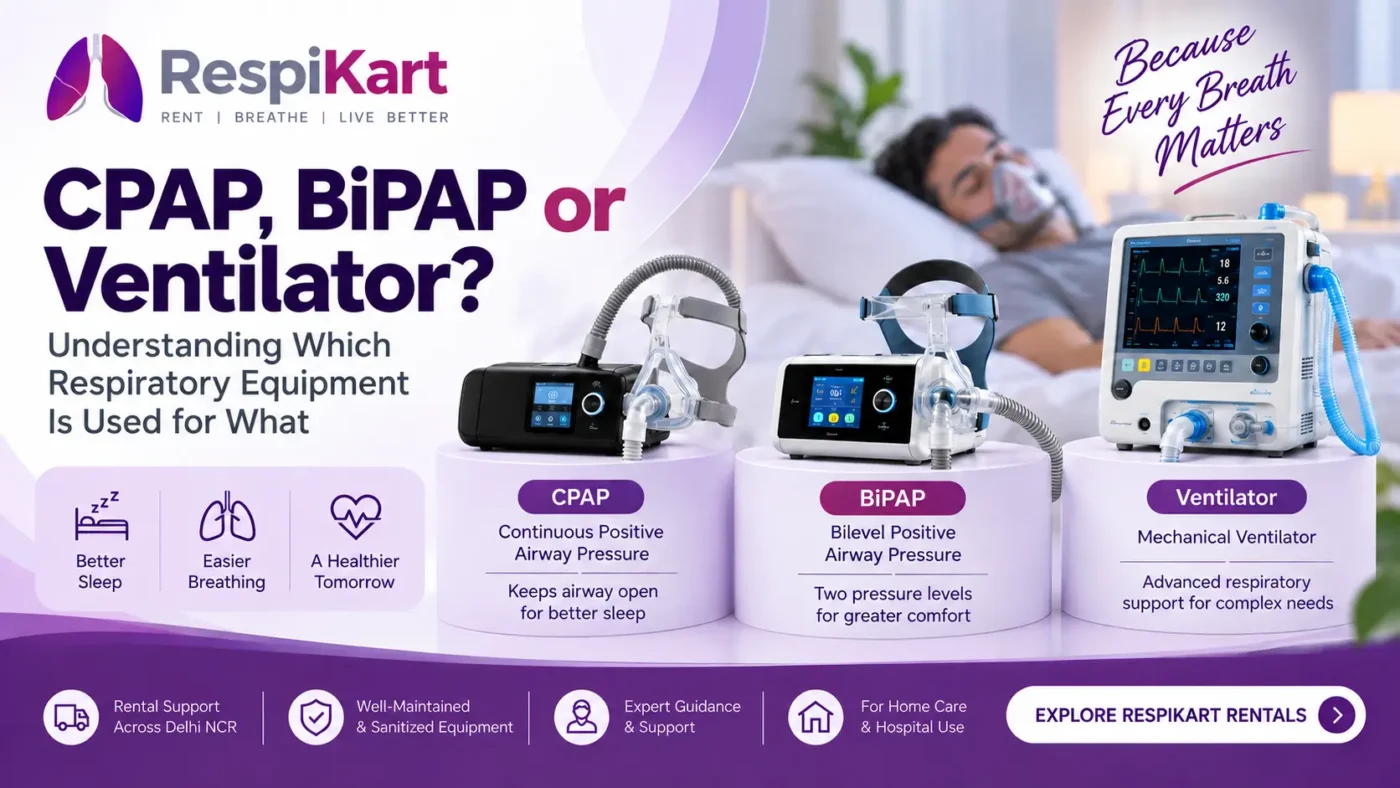
CPAP, BiPAP or Ventilator? Understanding Which Respiratory Equipment Is Used for What
CPAP, BiPAP and ventilators all provide respiratory support, but they are designed for different requirements. Learn the key differences, common applications and what to consider before renting respiratory equipment.
When a patient has difficulty breathing, sleep apnea, COPD, respiratory insufficiency or needs support after hospitalization, terms such as CPAP, BiPAP, NIV and ventilator are often used.
But these devices are not interchangeable. A CPAP machine, BiPAP machine and ventilator provide different types and levels of respiratory support.
The appropriate equipment depends on the patient’s condition, prescribed therapy, breathing requirements and the level of respiratory assistance required.
CPAP vs BiPAP vs Ventilator
A quick overview of the three major respiratory-support categories.
CPAP
Provides continuous positive airway pressure to help maintain an open upper airway, particularly during sleep.
Commonly associated with OSABiPAP
Provides separate pressure levels during inhalation and exhalation and can offer additional breathing assistance in appropriate patients.
PAP / NIV applicationsVentilator
Provides more advanced respiratory support with different ventilation modes, monitoring and alarms depending on the specific device.
Advanced respiratory support| Feature | CPAP | BiPAP | Ventilator |
|---|---|---|---|
| Pressure | Generally one continuous pressure | Two pressure levels | Multiple configurable ventilation parameters |
| Main Purpose | Helps keep the airway open | Provides different pressure during inhalation and exhalation | Provides advanced breathing assistance |
| Common Application | Obstructive Sleep Apnea | Selected respiratory and sleep-related conditions | Respiratory failure and intensive respiratory support |
| Interface | Usually non-invasive mask | Usually non-invasive mask | Non-invasive or invasive depending on the device |
| Typical Setting | Home / Sleep Therapy | Home / Hospital / NIV | Hospital / Critical Care / Selected Home Ventilation |
| Medical Supervision | Recommended | Important, especially for advanced modes | Required with specialist supervision |
What Is a CPAP Machine?
Understanding continuous positive airway pressure therapy.
CPAP stands for Continuous Positive Airway Pressure. A CPAP machine delivers a continuous flow of pressurized air through a mask while the patient sleeps.
The pressure helps keep the upper airway open and prevents airway collapse. CPAP is particularly associated with the treatment of Obstructive Sleep Apnea (OSA).
A typical CPAP setup can be understood simply as:
CPAP May Be Prescribed For
- Obstructive Sleep Apnea
- Sleep-related breathing disorders
- Snoring associated with airway obstruction
- Other conditions where continuous positive airway pressure has been prescribed
CPAP Machine on Rent in Delhi NCR
A practical option for patients with a prescribed temporary requirement.
For patients who need CPAP therapy temporarily, renting can be an alternative to purchasing a machine immediately.
Respikart CPAP Rental Options
Depending on availability, Respikart’s rental range includes CPAP machines from brands such as ResMed and Philips Respironics.
ResMed S9 CPAP
A CPAP option available within the Respikart rental range, subject to availability.
ResMed AirSense 11 AutoSet
An advanced CPAP option listed within the rental category, subject to availability.
Philips Respironics REMstar Auto CPAP
An auto CPAP option available depending on rental inventory.
DreamStation Auto CPAP
Available options may include models with heated humidification, subject to availability.
Rental pricing and availability can vary according to the machine, rental duration and current inventory.
What Is a BiPAP Machine?
Understanding bilevel positive airway pressure.
BiPAP stands for Bilevel Positive Airway Pressure. Unlike CPAP, which generally delivers one continuous pressure, BiPAP provides two pressure levels.
IPAP
Inspiratory Positive Airway Pressure
EPAP
Expiratory Positive Airway Pressure
The higher inspiratory pressure assists breathing in, while the lower expiratory pressure makes it easier to breathe out.
Because of this difference, BiPAP can provide more breathing assistance than conventional CPAP in appropriately selected patients.
When Is BiPAP Used?
Applications depend on the patient and prescribed therapy.
Depending on the specific device and physician’s prescription, BiPAP/NIV may be used for conditions such as:
- COPD
- Respiratory insufficiency
- Chronic respiratory failure
- Obesity hypoventilation syndrome
- Certain neuromuscular disorders
- Restrictive respiratory disorders
- Selected cases of sleep-disordered breathing
- Post-hospital or post-ICU respiratory support
Depending on availability, Respikart’s BiPAP rental range may include machines such as Philips Respironics BiPAP A30, Philips AVAPS, ResMed S9 BiPAP, Aeonmed BiPAP and other models.
CPAP vs BiPAP: What Is the Main Difference?
The simplest distinction is the pressure pattern.
CPAP
One continuous pressure.
Primarily helps maintain an open airway.
BiPAP
Two pressure levels.
Provides different inspiratory and expiratory pressures.
Advanced Modes
Certain BiPAP systems may provide additional modes such as volume-targeted support depending on the device.
The key point is that BiPAP is not simply a “stronger CPAP.” It is a different type of therapy with different pressure behavior and potential applications.
What Is NIV and How Does It Relate to BiPAP?
Understanding non-invasive ventilation.
You may also come across the term NIV, which means Non-Invasive Ventilation.
NIV refers to providing ventilatory support without using an invasive airway such as an endotracheal tube.
BiPAP-type systems are commonly used for non-invasive ventilation in appropriate clinical situations.
What Is a Ventilator?
Understanding advanced respiratory support.
A ventilator is an advanced form of respiratory support equipment that can assist or control breathing depending on the patient’s clinical requirements and the capabilities of the specific machine.
Ventilators can be used for both non-invasive ventilation and, depending on the device, invasive ventilation through an artificial airway.
Compared with a standard CPAP machine, ventilators can provide a wider range of ventilation modes, monitoring, alarms and respiratory-support options.
Advanced ventilators may include:
- Multiple ventilation modes
- Adjustable pressure and volume parameters
- Backup respiratory rates
- Patient monitoring
- Alarms
- Non-invasive ventilation
- Invasive ventilation on suitable models
When Is a Ventilator Used?
Ventilator therapy requires appropriate clinical supervision.
Depending on the clinical situation and specific ventilator, ventilatory support may be required for patients experiencing:
- Severe respiratory failure
- Inadequate ventilation
- Certain neuromuscular conditions
- Severe or complex respiratory disorders
- Post-ICU recovery
- Long-term ventilatory support under specialist supervision
BiPAP vs Ventilator: What Is the Difference?
Why the distinction can sometimes be confusing.
The difference can sometimes become less obvious because modern respiratory devices can have overlapping capabilities.
Some advanced BiPAP/NIV devices can provide substantial ventilatory assistance and may include backup rates and sophisticated modes.
Dedicated ventilators are generally designed to provide a broader range of respiratory-support functions.
The appropriate device depends on:
- Patient diagnosis
- Respiratory status
- Ventilation requirements
- Whether invasive or non-invasive support is required
- Prescribed mode
- Required pressure or volume targets
- Monitoring requirements
Which Equipment Is Generally Used for Sleep Apnea?
CPAP and BiPAP may both appear in sleep-related therapy.
Obstructive Sleep Apnea
CPAP is commonly prescribed because continuous positive airway pressure can help prevent upper-airway collapse during sleep.
More Complex Cases
Some patients may require bilevel therapy or another form of PAP/ventilatory support depending on their diagnosis and clinical requirements.
Which Equipment May Be Used for COPD?
The appropriate respiratory support depends on the clinical situation.
COPD is a broad respiratory condition, and the appropriate respiratory support depends on the patient’s clinical situation.
Some patients with COPD may require non-invasive ventilation, particularly when there is inadequate ventilation or elevated carbon dioxide levels.
In such situations, a doctor may prescribe BiPAP/NIV rather than standard CPAP.
Can Oxygen Be Used With CPAP or BiPAP?
Understanding the difference between pressure and oxygen therapy.
A CPAP or BiPAP machine primarily provides positive airway pressure.
An oxygen concentrator, on the other hand, produces oxygen-enriched gas.
In some circumstances, a doctor may prescribe supplemental oxygen alongside PAP therapy.
CPAP / BiPAP + Oxygen Concentrator
Oxygen should not be added or adjusted without medical advice. The requirement for supplemental oxygen depends on the patient’s oxygenation and clinical condition.
When Does Renting Respiratory Equipment Make Sense?
Rental can be useful when equipment is needed temporarily.
Short-Term Recovery
Respiratory support may be required temporarily after hospitalization or during home recovery.
Trial Before Purchase
Renting can allow a patient to use a prescribed machine before deciding whether purchasing is appropriate.
Temporary Home Care
Families may need respiratory equipment for a limited period during home-based care.
Travel / Relocation
Some patients may require equipment only for a temporary period away from their usual location.
Long-Term Requirement
Renting can also be considered when the user prefers not to make a large upfront purchase.
Home Respiratory Care
Rental services can provide access to equipment for prescribed home-care requirements.
What Should You Check Before Renting CPAP or BiPAP?
A practical checklist before accepting your rental equipment.
Confirm that the machine matches the equipment prescribed by your doctor.
Do not assume default settings are appropriate for every patient.
Make sure the appropriate mask/interface is available.
Check tubing, mask, filters, humidifier where applicable and power supply.
Ask whether the equipment has been cleaned, sanitized and checked before delivery.
Setup and operational guidance can be useful for unfamiliar users.
Confirm the rental period, extension process and applicable charges.
Confirm that the required model is available for your required rental period.
What Should You Check Before Renting a Ventilator?
Ventilator rental requires additional attention.
- Exact ventilator model
- Prescribed mode
- Required settings
- Patient interface
- Required accessories
- Alarm configuration
- Power requirements
- Backup power arrangements
- Installation/setup support
- Clinical supervision
- Emergency support arrangements
A ventilator should not be selected based solely on price or availability.
Common Mistakes When Choosing Respiratory Equipment
Avoid making the decision based only on machine specifications.
Choosing Only by Price
The cheapest machine is not necessarily the right machine for the patient’s prescribed therapy.
Assuming BiPAP Is Always Better
BiPAP is not automatically better than CPAP. They serve different purposes.
Using Someone Else’s Settings
Respiratory pressure settings should not simply be copied from another patient.
Confusing Oxygen With Ventilation
An oxygen concentrator and ventilator perform different functions.
Ignoring the Prescription
Knowing only “I need a breathing machine” is not enough.
Ignoring the Mask
An unsuitable mask can cause discomfort, leaks and poor therapy experience.
CPAP, BiPAP or Ventilator: Which One Do You Need?
Use this as a general educational guide, not as a substitute for medical advice.
Doctor Prescribed CPAP?
Look for an appropriate CPAP machine on rent.
Doctor Prescribed BiPAP/NIV?
Look for an appropriate BiPAP/NIV device matching the prescribed therapy.
Doctor Prescribed a Ventilator?
Look for the specific ventilator model or category prescribed by the medical professional.
Speak with your doctor first before renting respiratory equipment.
How Respikart Supports Respiratory Equipment Rental
Respiratory equipment for home-care rental requirements.
Respikart provides access to a range of medical and respiratory equipment for rental requirements.
CPAP Machines
Rental options for patients who have been prescribed CPAP therapy.
BiPAP Machines
Rental options for bilevel positive airway pressure or prescribed NIV support.
Ventilators
Advanced respiratory-support equipment for patients with an appropriate prescription.
Depending on availability, Respikart’s rental range also includes oxygen concentrators, oxygen cylinders and other medical equipment.
CPAP, BiPAP & Ventilator Rental in Delhi NCR
If you have been prescribed respiratory support and are looking for CPAP, BiPAP or ventilator equipment on rent in Delhi NCR, Respikart provides rental options based on the prescribed equipment and current availability.
View Respikart Rentals
Frequently Asked Questions
Common questions about CPAP, BiPAP and ventilator equipment.
Is CPAP the same as BiPAP?
Is BiPAP more powerful than CPAP?
Is a ventilator the same as a BiPAP machine?
Can I use a CPAP machine instead of BiPAP?
Can I rent a CPAP machine in Delhi NCR?
Can I rent a BiPAP machine in Delhi NCR?
Can I rent a ventilator for home use?
Do I need a doctor’s prescription?
Does CPAP or BiPAP provide oxygen?
What should I do if I don’t know which machine I need?
Final Takeaway
CPAP, BiPAP and ventilators support breathing in different ways.
CPAP
Helps maintain an open airway, particularly during sleep.
BiPAP
Provides two levels of positive airway pressure and can offer additional breathing assistance when appropriately prescribed.
Ventilator
Provides more advanced respiratory support for patients who require substantial assistance with ventilation.
The correct equipment depends on the patient’s diagnosis, prescribed therapy and respiratory-support requirements.
Need CPAP, BiPAP or Ventilator on Rent?
Share your prescribed equipment details with Respikart for rental assistance across Delhi NCR.
